OONI measurements indicate censorship remains

In its most recent measurement report, the Open Observatory of Network Interference [OONI] concludes that “while social media censorship in Azerbaijan appears to have been lifted, the media censorship remains.” These and other findings are based on the recent measurement report produced in partnership with OONI. 

Here are some highlights.

Blocked websites

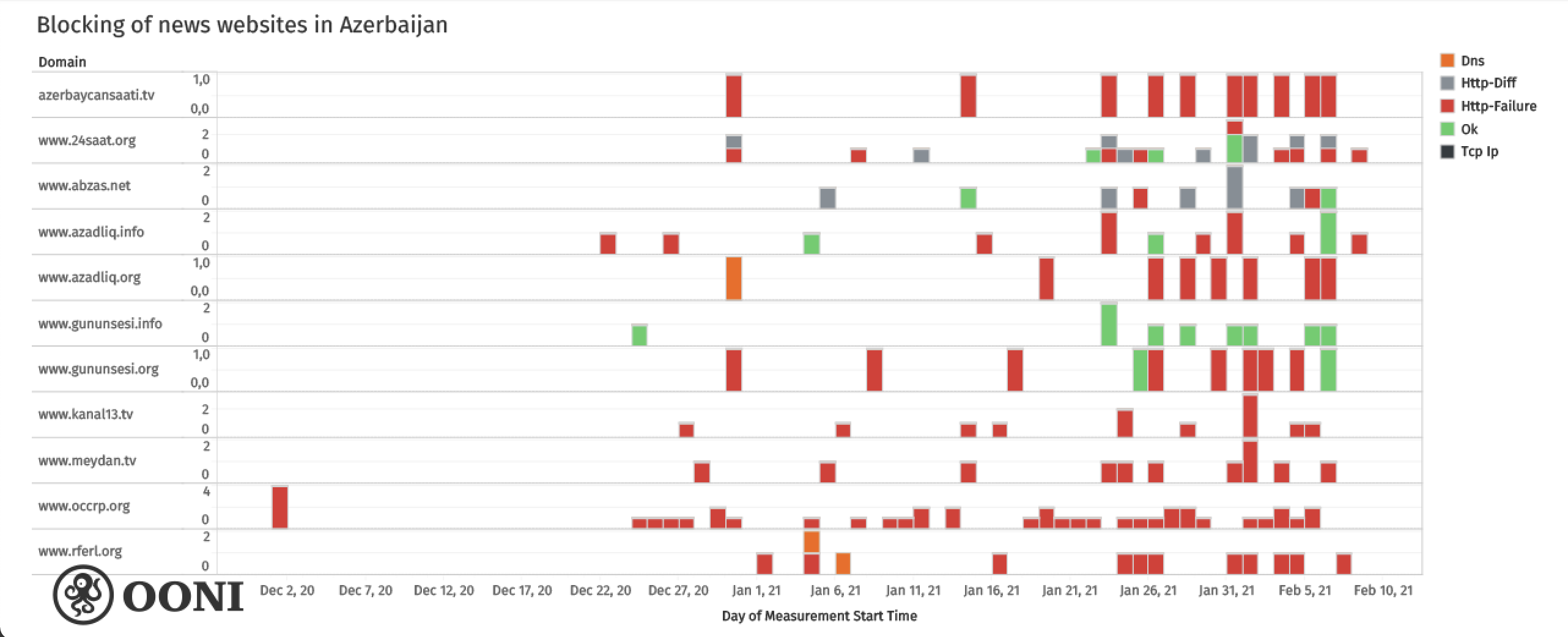
The news websites that presented signs of blocking in Azerbaijan (between December 2020 to February 2021) include:

🛑 azerbaycansaati.tv – at the time of blocking azerbaycansaati.tv in 2017, the Government of Azerbaijan claimed “a number of articles published” by the news website “included calls aimed at ‘forcible change of the constitutional order,’ ‘organization of mass riots,’ and other illegal activities.” 

🛑 www.24saat.org – a more detailed report about how 24saat.org was blocked can be found in this report, published by Qurium in 2017. 

🛑 www.abzas.net – DDoS attacks against abzas.net commenced on January 12, 2017, and lasted for eight days. During five full consecutive days, the website remained inaccessible until it was finally migrated to VirtualRoad.org’s secure hosting infrastructure.

🛑 www.azadliq.info – as a hosting provider for azadliq.info Qurium published this report about initial signs of blocking against this online news platform. The website was attacked numerous times according to documentation and forensic reports by Qurium. The technology deployed in these DDoS attacks was Allot and Sandvine DPI gear.

🛑 www.azadliq.org – the news website which represents the Azerbaijan Service for Radio Free Europe, was blocked on March 27, 2017. 

🛑 www.gununsesi.org – signs of DPI technology used in blocking gununsesi.org were once again documented by Qurium.

🛑 www.kanal13.tv – was among blocked websites in 2017 while its editor prosecuted [charges were dropped three years later.] 

🛑 www.meydan.tv – was also among the websites that were blocked in 2017 together with azerbaycansaati, azadliq.info and others. 

🛑 www.occrp.org – in response to the leaks about Azerbaijan Laundromat published by the Organized Crime and Corruption Research Project [OCCRP], the government of Azerbaijan suspended access to OCCRP’s website.

There is no official data on the number of blocked websites in Azerbaijan. The Ministry of Communication, High Technologies and Transportation has so far failed to provide accurate lists. This in itself is a violation of Article 13.3.6 of the Law on Information, Informatisation and Access to Information, which requests the Ministry to prepare a list of blocked websites if it has blocked access to a resource and the court upheld this decision.

In July 2018, the Prosecutor General’s Office launched criminal investigations against four news websites: criminal.az, bastainfo.com, topxeber.az and fia.az. The former two were accused of “knowingly spreading false information,” while the latter two were accused of “spreading unfounded, sensational claims in order to confuse the public.” Criminal.az is an independent website, known for its coverage of crime-related news, while bastainfo.com is affiliated with the opposition party Musavat. The latter two are run-of-the-mill online news websites.

In addition to the usual suspects, video streaming service Vimeo appeared to be briefly blocked during the testing coverage:

Circumvention

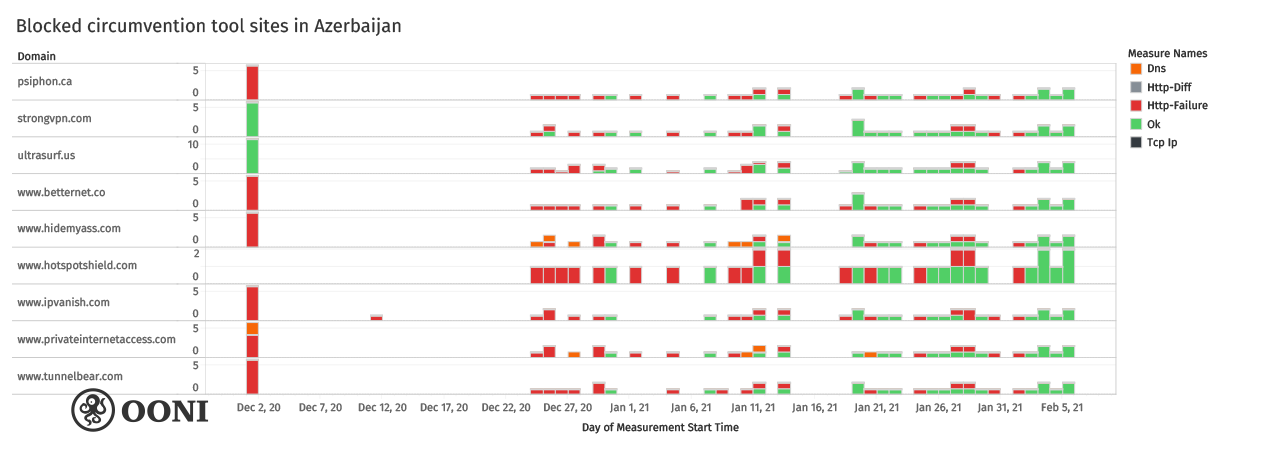
Several circumvention tool websites appear to have been interfered with in Azerbaijan during the testing period, as illustrated below:

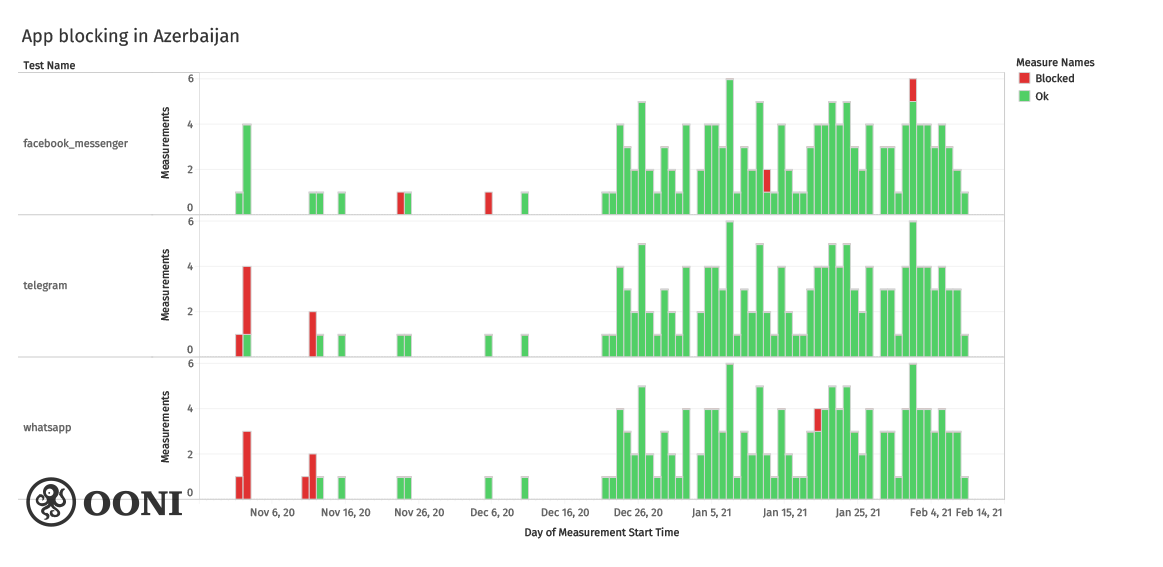
The good news are that access to social media sites and apps was restored during the testing period. The following chart shows that while WhatsApp and Telegram were blocked in November 2020, both apps (along with Facebook Messenger) have been accessible in recent months:

How you can help?

If you are interested in contributing to these tests you are welcome to try the following instructions

jailed journalist on hunger strike [updated January 31, 2025]

[Update] Polad Aslanov was unable to meet his lawyer, Elchin Sadighov. According to reporting by Meydan TV, Aslanov’s lawyer waited at the prison facility for several hours on January 31, but he still could not meet Aslanov. A few days prior, Aslanov complained about mistreatment and the prison conditions. His wife, Gulmira Aslanova, said Polad Aslanov was forced to call his family from the deputy chief’s office, in his presence. Aslanov considered this a violation of his rights and privacy. 

Polad Aslanov assessed this as a violation of the right to privacy.

Another inmate reportedly beat [Update] Polad Aslanov. The news was shared by Aslanov’s wife, who in protest stood outside the Penitentiary Service holding a sign that read “End Torture,” reported Meydan TV. Speaking to Meydan TV, Gulmira Aslanova said the head of the penitentiary service confirmed the beating, adding that the prison inmate received punishment for his act. But Aslanova believes this was not an isolated case, and that the beating was premeditated. She demands an end to intimidation against Polad Aslanov. 

[Update] According to Turan News Agency, the Supreme Court of Azerbaijan ruled on February 24, to reduce the original sentence of 16 years handed to the journalist by the Baku Court of Appeal to 13 years in prison, “taking into account extenuating circumstances – the absence of a previous conviction, as well as his marital status, the presence of a minor child.” Aslanov’s lawyer said the defense will be taking the case to the European Court of Human Rights.

[Update] Meydan TV reports that Aslanov was transferred to a medical facility on January 24, on his 19th day of hunger strike, due to health complications. 

[Update] According to OCMedia reporting, imprisoned journalist Aslanov self-harmed on January 11 after his right to a weekly phone call was denied. After the incident, the journalist’s right was granted, Aslanov’s wife, Gulmira Aslanova, told the media.  

[Update] On January 7, 2022, Aslanov declared he was going on a hunger strike, according to reporting by Meydan TV. In an interview, Aslanov’s wife, Gulmira Aslanova, said that her husband wants the Supreme Court to finally review the appeal that the journalist’s lawyer submitted in February 2021, following the decision by the Baku Court of Appeal that upheld the original sentence that sentenced the journalist to 16 years. 

[Update] According to Meydan TV, who spoke with Aslanov’s wife, the journalist is on a hunger strike in response to pressure against him at the prison facility. “The prison authorities believe that Polad Aslanov is influencing other inmates and teaching them how to resist and protest. There was an inmate who went on a hunger strike in response to prison management demanding bribes in exchange for the parcels delivered by family members. He was pressured to stop the hunger strike. He was placed in solitary confinement. As a result, he wrote a forced confession stating that he had not asked anyone to pay for anything. And that he was punished not because of corruption, but because he violated the prison’s rules. For days now, the prison has been without water. They [the prison authorities] are implying that the reason there is no water is because of Polad Aslanov,” explained Gulmira Aslanova.  

[Update] On May 18, jailed journalist, Aslanov, on hunger strike in protest against ill-treatment by the prison management, confirmed Aslanov’s wife.  

[Update] On March 3, Polad Aslanov announced his decision to stop the hunger strike. Although the family members and the Ombudsman’s office confirmed this decision, there is no further information on what caused Aslanov to make this decision.   

[Update] On March 1, jailed editor Polad Aslanov marked the 29th day of his hunger strike, according to Aslanov’s wife. 

[Update] Following a visit by a representative from the Red Cross on February 21, Polad Aslanov was placed in a separate cell under medical supervision on February 22, said Aslanov’s wife, Gulmira Aslanova. He will remain in quarantine for the next 14 days, during which time no visitors will be allowed, explained Aslanova. 

[Update] Aslanov’s wife, Gulmira Aslanova, told Turan News Agency, on February 16, that Aslanov remains on hunger strike.

[Update] On February 15, the Baku Court of Appeal dismissed Aslanov’s appeal, ruling to keep him behind bars.

Polad Aslanov, editor of the Xeberman news website, has been on a hunger strike since February 1. His wife, Gulmira Aslanova, told Caucasian Knot that her husband is complaining of kidney and stomach pains as a result of the hunger strike. 

Aslanov was arrested in 2019 and sentenced to 16 years in prison in November 2020 on bogus high treason charges. The State Security Service accused Aslanov of allegedly betraying his country by providing information to Iran. The journalist refutes the charges, saying he was arrested over his reporting on extortion by the members of the State Security Services of Azerbaijan. 

The journalist was additionally charged with Article 134 (threat to kill) of the Criminal Code. However, this accusation was dropped in court. 

Aslanov is the second journalist to have gone on a hunger strike in Azerbaijan. In addition to Aslanov, jailed journalist Afgan Sadigov marked the 95th day of the hunger strike on February 7.  This is Aslanov’s third hunger strike since his imprisonment. 

Reporters Without Borders stated on February 9, calling on the Azerbaijani authorities to provide urgent medical assistance to Polad Aslanov.

At present, there are three journalists behind bars in Azerbaijan. They are Polad Aslanov, Afgan Sadigov,  and Elchin Ismayilli (a seven-year sentence on extortion charges, editor and founder of the news website Kend). 

Correction: The Previous version of the article said four journalists were currently behind bars. But Ikram Rahimov, editor of the news website Realliq, who was sentenced to a three-year sentence on extortion charges, was released in September 2020. 

new decree on the State Control Information System

On January 30, President Ilham Aliyev, signed a decree “on the procedure for the operation of the State Control Information System”, reported Turan News Agency. The information system was set up in March of last year when President Aliyev, introduced it in a new order. At the time, local media reported that the order aims at introducing “additional measures to increase efficiency in public administration, informs the press-service of the Azerbaijani head of state.” 

On paper, the new system “serves to increase the efficiency of work in the Administration of the President, in the field of organizing state control and ensuring executive discipline, electronic monitoring of the status of execution of decrees, orders, and instructions of the President of the Republic of Azerbaijan, First Vice President, and the head of the Presidential Administration.” 

But what does it mean in reality?

A few things according to Khaled Aghaliyev. While there is a need for transparency, checks and balances on government implemented decisions, documents, and policies, whether the new system allows for that is yet to be seen. “This system should be accessible to everyone”, said Aghaliyev in an interview with Astna on February 6. However, the new decree does not provide “direct indications of this”. There is also the issue of track record.

Aghaliyev in his interview mentioned the law “On Freedom of Information” that was adopted 15 years ago. However, over the years, too many changes were made to the law that its accountability power over holders of information which also includes the president as well as all other officials, has been weakened. Had the provisions of the law on Freedom of Information worked, there would be no need for creating a new system believes Aghaliyev. 

As for access to the information, a series of amendments to the Law on Right to Obtain Information have hindered the right to access information. As a result of these changes, access to information was only allowed in cases when the request did not contradict the protection of political, economic, military, financial, credit, and currency interests of the Azerbaijan Republic. That in addition, “preserving public order, health, and morality, as well as rights and freedoms of other persons, commercial and other economic interests, the purposes of securing reputation and impartiality of the court and proper continuance of preliminary investigation on criminal cases.” But the use of such expressions as “protection of interests in political, economic, military, monetary and currency policy fields” according to this review of Azerbaijan’s national legislation on access to information, is not only not acceptable but, in fact, goes against the Constitution of Azerbaijan.

These shortcomings have been highlighted in a series of reports produced by local organizations such as the Center for Legal Initiatives. In its 2016 report, the organization also reported that the new amendments categorized information on financial transactions data as private information and therefore restricted for access. Meanwhile, an amendment to the laws of state register of legal persons and to the Tax Code, classified information about founders of commercial legal entities and commercial stakes as confidential. 

Under normal circumstances, the most effective, the proven control mechanism is the mass media. However, in Azerbaijan, independent media, is often silenced, through various forms of persecution, including arrests, detentions, intimidation tactics, blackmail, and more. As a result of persistent threats to an independent media environment Azerbaijan’s rankings on global media freedom rankings have been poor, often described as not free, or partially free. 

The same applies to online media platforms, many of which have been targeted over the years and since 2017, consistently blocked by government bodies. 

Why now? 

On February 1, President Aliyev in an interview with national television AzTV said, a new approach has begun within the state administration. “My patience running thin”, said the President in an interview, adding the need for public control. He has said this before too, like during the trip to Mashtaga village outside of the capital Baku in 2018, where yet again, President Aliyev talked about strengthening public control. Then in 2019, he repeated the urgency of such control mechanisms during a meeting with the Cabinet of Ministers. But since his ascent to power in 2003, President Aliyev, has himself (through presidential decrees and orders) deliberately weakened public oversight. That in addition, to harassment of non-governmental organizations, tightening of domestic legislation, the arrest of activists and outspoken critics of the government, among them journalists and rights efenders – have all been taking place under his watch. Perhaps a good place to start would have been naming the new system, not State Control but Public Control? 

Regardless, Azerbaijan Internet Watch shares the concerns over the applicability and efficiency of the new system in the absence of reforms and will continue to monitor the developments regarding the newly set up system on information controls. 

inspired lawmakers rush to discuss social media regulations in Azerbaijan

On May 29, now former President Trump signed an executive order to “pressure regulators, including the Federal Communications Commission and the Federal Trade Commission, to come up with new rules that would curtail that immunity.” The order came shortly after Twitter fact-checked Trump’s tweet “over a false assertion that mail-in voting leads to widespread fraud.” 

Two days later, lawmakers in Azerbaijan were back to discussing the possibility to control social media platforms. Speaking at the parliament session, member of the parliament and the ruling New Azerbaijan Party Siyavush Novruzov said, the US was finally seeing that the seeds it has been sowing across the world, are turning against America. He reminded the parliament that he raised the issue before, recalling saying, foreign-based entities, bear no responsibility for their actions while supporting terrorism, assassination attempts against world leaders, and extremism. The MP did not give examples to specific cases and instead said at the time when the issue of controlling social media platforms was mentioned, it was interpreted as a violation of the freedom of the media. 

Speaking on the same issue, another MP Javid Osmanov, said, it was time for Azerbaijan to adopt a similar law especially to strengthen the national security in Azerbaijan. 

This is not the first time Azerbaijan lawmakers discuss introducing regulatory measures for social media platforms. 

In 2018, MP Hadi Rajabli, said social media platforms that engage in anti-government propaganda must but controlled. Rajabli has previously criticized social networks. “Harmful factors such as social media, Facebook, messenger apps and the like play a big role in the disintegration of families, divorces, and early marriages, because many people use social media for entertainment and end up facing serious problems,” Rajabli said during one parliamentary discussion.  Another MP Araz Alizada went as far as to claim, normal people do not use social media platforms. 

In 2017, Azerbaijani lawmakers approved criminal charges for defamation against the president on social media platforms, the use of censorship during martial law; and restricting media access to information on private property and businesses. According to changes to Article 321(1) of the Criminal Code, a maximum sentence of five years in prison was introduced for defaming or humiliating the honor and dignity of the president in mass media and social media. The changes also increased the fine from AZN1500 to AZN2500.

In February 2018, ahead of the snap presidential election, the Central Election Commission Chairman Mazahir Panahov expressed concern over social media platforms. He claimed they have grown uncontrollably and are difficult to regulate during the election process. At a National Parliament Human Rights Committee meeting in January 2017, Chairman of the Press Council Aflatun Amashov discussed creating legislation to monitor and regulate bloggers and social media platforms. Other members of parliament supported the potential legislation, saying that there is a “serious need to regulate this field.” While no pieces of legislation have been proposed this is likely to change in the upcoming February discussions at the national parliament.

In 2015, the Ministry for Communication and Hight Technologies (now the Ministry of Transportation, Communication and High Technologies) said it will require some social media and instant messaging services, including Facebook, WhatsApp, Skype, and Viber, to obtain a license in order to operate in Azerbaijan. While no progress has been towards enforcing this it would be interesting to watch the upcoming discussions at the parliament. 

Azerbaijani lawmakers have been eyeing Turkey’s recent laws on social media including the controversial bill adopted in July 2020 that requires social media giants, establish local representatives, store user data locally and comply with orders for content removal, face fines and slowed bandwidth in the case of noncompliance. 

resident of Mingachevir city beaten by the police over social media posts

January 29, 2021 – Resident of Mingachevir city, Sardar Asgarov was taken to local police, beaten, and forced to apologize over his criticism of the local government officials on social media. 

In an interview with Meydan TV, a Berlin-based online news platform, covering Azerbaijan, Asgarov said, a man showed up at his door on January 26 in the morning telling him, he was coming from the Mingachevir Employment Center. Once Sadigov stepped outside of his door, three other men showed up and attacked Sadigov. 

According to Sadigov he was then taken to the local police where the city’s deputy chief, Javid Talibov slapped him, used derogatory language and told him who was he to criticize local administration, and the head of the police on social media. “He then forced me to kneel, and to apologize while Talibov was filming me with his phone,” Sadigov told Meydan TV. 

The same day, Sadigov was fined and let go. 

Sadigov said both his mobile phones that were taken by the police were formated and his accounts on social media platforms were deleted. “The deputy chief told me if I criticize local authorities again, he will find a way to arrest me.”

In the meantime, Mingachevir City Police told Meydan TV, Sadigov was detained for hooliganism and fined for 50AZN and that Sadigov’s claims about violence and threats he was subject to at the police are not true. Similarly, the city administrative office refuted Sadigov’s claims that he was detained on the orders of the office. The office also said they consider Sadigov’s comments on social media as slander. 

Sadigov’s posts on social media criticized one of the city government departments for withholding salaries of women employees, and not helping them during the pandemic. Sadigov also criticized the city police for preventing these women from protesting.  

free or not free – the battle over internet freedom in Azerbaijan

On January 26, during the appointment of the new head for the Ministry of Transportation, Communication and High Technologies, Rashad Nabiyev, president Ilham Aliyev in a video conference boasted about free, uncensored internet in Azerbaijan. “Everybody knows, internet in Azerbaijan is free, there is no censorship, no restrictions,” said the President during the video conference. 

But international watchdogs, as well as local activists, beg to disagree. In its most recent ranking of Internet Freedom across the world, Freedom House ranks Azerbaijan as “not free”. Among some of the factors contributing to this ranking are outdated infrastructure, state control over information and communication technology, government manipulation of the online information landscape, presence of blocked websites, jailed critics over their online activism to name a few. Similarly, activists and opposition party representatives say, if President Aliyev’s claims are true, then why do activists are called in for questioning after their critical posts on social media platforms? Or why do opposition activists experience internet disruptions during rallies? 

And this has been the case for over a decade now. Over the years of exercising control over internet freedom in Azerbaijan, the ruling Baku has successfully relied on defensive techniques that require widespread filtering and direct censorship; legal measures techniques that often involve the use of legislation on defamation, and slander to deter users of online platforms from posting critical of the government content; and finally, offensive techniques, such as cyber-attacks against civil society. 

These techniques, defined by Ronald Deibert, is how authoritarian regimes have become savvy at restricting access to their users relying on technology, legal and extralegal techniques, described above. Suffice to say, that these techniques are widely implemented not just in Azerbaijan but other countries where governments exercise full control over the internet domain. Moreover, all of these restrictions have been documented in recent years, concluding a rather stark difference to what President Aliyev claimed on January 26, that Azerbaijan’s internet freedom is far away from being free.

This is also reflected in the work carried out by Azerbaijan Internet Watch. Just within last year alone, Azerbaijan Internet Watch has documented and reported on the score of cases where the evidence suggests to the contrary of what President Ilham Aliyev claimed last month. From discussions on control mechanisms over social media to arrests and intimidation of activists for their online criticisms to internet restrictions and disruptions, and the use of sophisticated surveillance technology to stifle independent voices. That in addition to lack of quality infrastructure and services, is yet to indicate, how does the President come to a conclusion that access to the Internet is free and unrestricted. 

forced posts removal from Facebook continue in Azerbaijan

On January 13, Elmir Abbasov, a member of NIDA movement, was taken against his will to local police station in the city of Sumgayit where he was questioned over his Facebook post about president Ilham Aliyev.

In his interview with Azadliq Radio, Abbasov said, he was on his way to a shop when a man told Abbasov to get into the car for a chat at the police station. Abbasov, who said without a warrant he won’t be going anywhere, was then shuved into the car and taken to the station by force.

Abbasow spent the next two hours at the police station, where he was informed that the reason for his interrogation was a Facebook post, he wrote about the President. He was told to immediately delete the post. 

AIW spoke with Abbasov about the content of the post which is no longer available on the social media platform.

Under normal circumstances this post would not be considered critical but in Azerbaijan, the sensitivity around certain personalities as in the case of the president are common and not tolerated. 

In the case of Abbasov’s post, it was a comment about an economic system heavily reliant on hydrocarbons. This has been voiced by international financial institutions, experts and pundits alike for a long time.

Similarly, Abbasov’s post stressed the country’s economy, over reliance to fluctuating oil price as a result of its dependence and recommended that the president takes recommendations by independent economists seriously rather than dismiss them. 

Three days before Abbasov was taken to the police and ordered to delete his post from Facebok, one freelance journalist [name omitted due to safety concerns] was told to delete a Facebook post, that was critical of the local law enforcement. Namely, the journalist desrcibed seeing one officer, take a bribe from a man stopped on the street as part of the COVID measures in place. The source told AIW, the measure was taken in an attempt to keep the reputation of the local agency clean.

opposition party boss seeks justice at the European Court of Human Rights

Ali Karimli, the head of the opposition Popular Front Party, and his spouse Samara Seyidova said they are preparing for the European Court of Human Rights, having received no response from domestic courts concerning their home internet connections being cut off since April of last year.  

AIW was documenting Karimli’s case since April 13 when the opposition boss encountered connection issues before a live interview with journalist Sevinc Osmangizi [for the detailed timeline please visit here]. 

Since then, despite numerous attempts, the leader of the Popular Front failed to resolve the problem through domestic courts. Most recently, the ruling of the Baku Appeal Court confirmed previous court decisions, thus ruling against the party head. The court of appeal is the final legal entity to accept and deal with similar complaints. “In such cases, the appeal to the Supreme Court is not expected. This is why we intend to take our complaint to the European Court,” said one of the lawyers defending Karimli in an interview with Azadliq Radio. 

The defendants are the Ministry of Transportation, Communication and High Technologies, Azercell mobile operator, AzQTEL internet provider, the Ministry of the Interior, State Security Service, and the Special State Protection Service. According to Karimli his rights were violated under Articles 6 (right to a fair trial), 8 (right to respect of family and private life), 10 (freedom of expression), 14 (prohibition of discrimination), and 18 (Limitation on use of restrictions on rights) of the European Convention on Human Rights

Karimli’s access to the internet was restored twice since April. Once on January 12 and in May but only briefly, for few hours. Karimli is certain the decision to cut him and his familly off internet is political. Government supporters think otherwise. Siyavush Novruzov, a parliament member, blamed Karimli for not paying his bills on time and laying the responsibility on the government. In the meantime, Azercell, the mobile operator [with ties to the government], said in a statement it does not discreminate among its customers based on their political views. 

But while government representatives and affiliated companies claim otherwise, Karimli and his family members had their rights violated. According to a fact checking platform FaktYoxla Karimli’s case, goes against severeal articles and guarantees specieifed by the national constitution and can be described as an unlawful interference. Specifically, it is against the right to equality and freedom of expression, right to live in safety and privacy. In addition, actions against Karimly contradict the provisions of the Law on Telecommunications, Access to Information and Personal Information and are criminalized by criminal law.

AIW will continue documenting developments in the case of Ali Karimli and the family. 

fresh media reforms raise concern [updated]

On January 12, President Ilham Aliyev signed a decree “on deepening media reforms in the Republic of Azerbaijan.” As a result, the newly established Azerbaijani Agency for Media Development will replace the State Support Fund for Mass Media Development and will have all the rights of the former institution. In tandem, new media law is also being drafted by the Administration of the President for the President’s review in two months.

The decree was welcomed by many mouthpiece media, including the SES [Voice] media group. Its director, Bahruz Guliyev said, there was a need for fundamental reforms, transparency, and public demand. “Since the Azerbaijani law on mass media fails to meet the demands of the time, it requires to be revised, should be improved, and one of the main tasks of the new body is to develop a draft law ‘On media’ replacing the outdated law,” he added.

Guliyev has been a long advocate of the government of Azerbaijan. SES was established in 1991. In 2015, Guliyev in an interview with YAP [Yeni Azerbaijan Partiyasi – the ruling New Azerbaijan Party] said, the platform had a tough path having survived the “pressure and censorship from the government.” The reason for the pressure faced in the hands of the government claimed Guliyev was that “the newspaper was writing about Azerbaijani realities.”

Two years prior, Guliyev was shouting at ODIHR representative in the aftermath of the rigged presidential election in Azerbaijan accusing ODIHR of having prepared the entire preliminary statement long before coming to Azerbaijan. Just two months earlier, Guliyev was among the recipients of a free apartment by President Aliyev in the new government-built residential complex for journalists. 

The charter

The Media Development Agency is a public legal entity carrying out activities to support the development of media, organise the training of media specialists and their additional education, stimulate the activities of audiovisual, print, online media and information agencies (media subjects), journalists and other media workers, as well as the introduction of new information and communication technologies and innovations in the field of media.

The agency’s tasks include organising the implementation of projects that are important for the state and society, aimed at developing, strengthening economic independence and improving the activities of these media entities, as well as in accordance with the “Concept of state support for the development of the media in the Republic of Azerbaijan.” The organisation also takes measures to strengthen the economic independence of media entities, creates financial support for the development of media, acts as a state customer for the production and distribution of audiovisual products, and holds competitions for this purpose.

Punitive measures

According to its charter, the agency can take measures to protect state and commercial secrets. In case of non-compliance with the information published in the online media within the requirements provided by law, the agency can contact the relevant authorities in order to take measures in this regard.

It also has the authority to take measures in accordance with the Code of Administrative Offenses in case of detecting signs of an administrative violation in the field of print and online media, and in case of detection of signs of a crime – to provide information to the appropriate authority [the powers are similar to the National Council on Television and Radio which can and has in the past deprive radio and television companies of air hours]. 

It will also be accountable to the head of state.

The agency’s governing bodies – a Supervisory Board of six members – and the executive director, are appointed by the head of state. Ahmed Ismayilov, is the executive director of the new fund. In April 2020, he was appointed the executive director of the now defunct Media Development Support Fund. Ismayilov, 40, is a lawyer by education. Previously he has worked in various government institutions, including the Heydar Aliyev Foundation, managed by the first lady and the first vice president Mehriban Aliyeva. He is a member of the ruling Yeni Azerbaijan Party. 

Previously, the central executive body supervising the media in Azerbaijan was abolished when the country joined the Council of Europe in 2001.

Reactions

In his Op-ed, the director of Turan News Agency, Mehman Aliyev wrote

Until now, the press supported by the state legally and illegally, has served the interests of the authorities, but not society; it has led to a deplorable situation in various areas, including the media themselves.

In the meantime, notes Aliyev, while the new fund’s focus is on technological aspects of media development there is no mentioning of protection of free press whatsoever. Lack of avenues for independent media in the country and impunity is the challenge, not the lack of technological equipment notes Aliyev.

Alasgar Mammadli, the media law expert, criticized the new agency’s broad, it’s vaguely defined legal powers and the absence of any wider preliminary discussions in the society ahead of its approval.

In an interview with ASTNA, lawyer Khalid Aghaliyev said while it is too early to say anything about the new agency, the role its predecessor played in Azerbaijan, should not be underestimated: 

State Support Fund for the Development of Mass Media, established 11 years ago, was one of the institutions that played a key role in controlling the media in Azerbaijan. This organization gradually began to penetrate the media in 2009 and was able to make the print media almost completely dependent on it in a short time. 

[…]

The image of this Fund, especially in the last 2-3 years, was seriously damaged, and its main mission was fully exposed. In this regard, it was entirely expected that the government would liquidate the Fund or present it in a new image. Therefore, I do not see a serious difference in principle between the abolished and the newly created institution. The new body will likely carry out the same mission as the Fund in reality. 

[…]

Powers such as punishment with regard to the content and directing the content are very dangerous. Empowering an institution created by the state with such powers is incompatible with the right to freedom of expression. Legislation already delineates the boundaries of freedom of expression, and any other interference is unacceptable.

Two days after the decree was signed, Vugar Safarli, the former fund’s executive director [Ahmed Ismayilov’s predecessor] who was dismissed from his post in April 2020, was arrested on charges of embezzlement. During the investigation, the prosecutor’s office seized some 6million AZN [3.5million USD] from Safarli’s personal bank accounts. Safarli was expelled from the ruling party on February 15. 

Now, the critics, and media practitioners must wait until the new media law is drafted. Given the country’s recent history of media crackdown, the chances of having transparent legislation are slim, while its implications worrying.   

Azerbaijan among top VPN users worldwide according to recent reports

Azerbaijan ranked among the top countries where VPN services were in high demand last year between September and November during the 44-day war between Armenia and Azerbaijan. According to Proprivacy and NordVPN research “global events in 2020 have caused surges in VPN demand, as citizens from Belarus to Hong Kong set out to secure their online privacy and protect themselves from censorship and persecution for their online activities.” Azerbaijan was among the top ten countries where interest in VPN providers spiked in 2020.

Source: https://proprivacy.com/privacy-news/vpn-spikes-2020

“In late September, as the violent clashes between Azerbaijan and Armenia continued to escalate over the Nagorno-Karabakh region, the Ministry of Transport, Communications and High Technologies of Azerbaijan took action to restrict internet access across the country. Extensive social media restrictions were put in place that took down major communications services, including: Facebook, WhatsApp, YouTube, Instagram, Twitter, Zoom, Skype, Messenger,” said the joing report.

In a different report Azerbaijan was once again among the top countries where the biggest increase of VPN usage was recorded. “On September 29, NordVPN saw online privacy tool usage increased by 148 times due to internet access restrictions,” said the report. 

Not surprisingly, NordVPN, a Lithuanian by origin, was among the top targeted providers by pro-government media outlets, which said the service was owned by Armenians and therefore users in Azerbaijan should avoid using this provider.  

Finally, Surfshark, analyzed 185 countries and their social media blocking practices from 2015 to the present day. There Azerbaijan is ranked among the most recent cases of social media blocking [Surfshark too was discredited by Azerbaijan media outlet as being allegedly owned by Armenians, even though the company is registered in BVI. You can check out it’s ranking here.] 

Source: https://surfshark.com/social-media-blocking

On November 10 Azerbaijan and Armenia signed an agreement to end the active phase of fighting. On November 12, the government lifted the blocking and access to all social media platforms.  

For disruptions observed throughout the 44 days read this timeline. For the country ranking in Internet Freedom, you can read the most recent report on Net Freedom by Freedom House here.