opposition party boss seeks justice at the European Court of Human Rights

Ali Karimli, the head of the opposition Popular Front Party, and his spouse Samara Seyidova said they are preparing for the European Court of Human Rights, having received no response from domestic courts concerning their home internet connections being cut off since April of last year.  

AIW was documenting Karimli’s case since April 13 when the opposition boss encountered connection issues before a live interview with journalist Sevinc Osmangizi [for the detailed timeline please visit here]. 

Since then, despite numerous attempts, the leader of the Popular Front failed to resolve the problem through domestic courts. Most recently, the ruling of the Baku Appeal Court confirmed previous court decisions, thus ruling against the party head. The court of appeal is the final legal entity to accept and deal with similar complaints. “In such cases, the appeal to the Supreme Court is not expected. This is why we intend to take our complaint to the European Court,” said one of the lawyers defending Karimli in an interview with Azadliq Radio. 

The defendants are the Ministry of Transportation, Communication and High Technologies, Azercell mobile operator, AzQTEL internet provider, the Ministry of the Interior, State Security Service, and the Special State Protection Service. According to Karimli his rights were violated under Articles 6 (right to a fair trial), 8 (right to respect of family and private life), 10 (freedom of expression), 14 (prohibition of discrimination), and 18 (Limitation on use of restrictions on rights) of the European Convention on Human Rights

Karimli’s access to the internet was restored twice since April. Once on January 12 and in May but only briefly, for few hours. Karimli is certain the decision to cut him and his familly off internet is political. Government supporters think otherwise. Siyavush Novruzov, a parliament member, blamed Karimli for not paying his bills on time and laying the responsibility on the government. In the meantime, Azercell, the mobile operator [with ties to the government], said in a statement it does not discreminate among its customers based on their political views. 

But while government representatives and affiliated companies claim otherwise, Karimli and his family members had their rights violated. According to a fact checking platform FaktYoxla Karimli’s case, goes against severeal articles and guarantees specieifed by the national constitution and can be described as an unlawful interference. Specifically, it is against the right to equality and freedom of expression, right to live in safety and privacy. In addition, actions against Karimly contradict the provisions of the Law on Telecommunications, Access to Information and Personal Information and are criminalized by criminal law.

AIW will continue documenting developments in the case of Ali Karimli and the family. 

fresh media reforms raise concern [updated]

On January 12, President Ilham Aliyev signed a decree “on deepening media reforms in the Republic of Azerbaijan.” As a result, the newly established Azerbaijani Agency for Media Development will replace the State Support Fund for Mass Media Development and will have all the rights of the former institution. In tandem, new media law is also being drafted by the Administration of the President for the President’s review in two months.

The decree was welcomed by many mouthpiece media, including the SES [Voice] media group. Its director, Bahruz Guliyev said, there was a need for fundamental reforms, transparency, and public demand. “Since the Azerbaijani law on mass media fails to meet the demands of the time, it requires to be revised, should be improved, and one of the main tasks of the new body is to develop a draft law ‘On media’ replacing the outdated law,” he added.

Guliyev has been a long advocate of the government of Azerbaijan. SES was established in 1991. In 2015, Guliyev in an interview with YAP [Yeni Azerbaijan Partiyasi – the ruling New Azerbaijan Party] said, the platform had a tough path having survived the “pressure and censorship from the government.” The reason for the pressure faced in the hands of the government claimed Guliyev was that “the newspaper was writing about Azerbaijani realities.”

Two years prior, Guliyev was shouting at ODIHR representative in the aftermath of the rigged presidential election in Azerbaijan accusing ODIHR of having prepared the entire preliminary statement long before coming to Azerbaijan. Just two months earlier, Guliyev was among the recipients of a free apartment by President Aliyev in the new government-built residential complex for journalists. 

The charter

The Media Development Agency is a public legal entity carrying out activities to support the development of media, organise the training of media specialists and their additional education, stimulate the activities of audiovisual, print, online media and information agencies (media subjects), journalists and other media workers, as well as the introduction of new information and communication technologies and innovations in the field of media.

The agency’s tasks include organising the implementation of projects that are important for the state and society, aimed at developing, strengthening economic independence and improving the activities of these media entities, as well as in accordance with the “Concept of state support for the development of the media in the Republic of Azerbaijan.” The organisation also takes measures to strengthen the economic independence of media entities, creates financial support for the development of media, acts as a state customer for the production and distribution of audiovisual products, and holds competitions for this purpose.

Punitive measures

According to its charter, the agency can take measures to protect state and commercial secrets. In case of non-compliance with the information published in the online media within the requirements provided by law, the agency can contact the relevant authorities in order to take measures in this regard.

It also has the authority to take measures in accordance with the Code of Administrative Offenses in case of detecting signs of an administrative violation in the field of print and online media, and in case of detection of signs of a crime – to provide information to the appropriate authority [the powers are similar to the National Council on Television and Radio which can and has in the past deprive radio and television companies of air hours]. 

It will also be accountable to the head of state.

The agency’s governing bodies – a Supervisory Board of six members – and the executive director, are appointed by the head of state. Ahmed Ismayilov, is the executive director of the new fund. In April 2020, he was appointed the executive director of the now defunct Media Development Support Fund. Ismayilov, 40, is a lawyer by education. Previously he has worked in various government institutions, including the Heydar Aliyev Foundation, managed by the first lady and the first vice president Mehriban Aliyeva. He is a member of the ruling Yeni Azerbaijan Party. 

Previously, the central executive body supervising the media in Azerbaijan was abolished when the country joined the Council of Europe in 2001.

Reactions

In his Op-ed, the director of Turan News Agency, Mehman Aliyev wrote

Until now, the press supported by the state legally and illegally, has served the interests of the authorities, but not society; it has led to a deplorable situation in various areas, including the media themselves.

In the meantime, notes Aliyev, while the new fund’s focus is on technological aspects of media development there is no mentioning of protection of free press whatsoever. Lack of avenues for independent media in the country and impunity is the challenge, not the lack of technological equipment notes Aliyev.

Alasgar Mammadli, the media law expert, criticized the new agency’s broad, it’s vaguely defined legal powers and the absence of any wider preliminary discussions in the society ahead of its approval.

In an interview with ASTNA, lawyer Khalid Aghaliyev said while it is too early to say anything about the new agency, the role its predecessor played in Azerbaijan, should not be underestimated: 

State Support Fund for the Development of Mass Media, established 11 years ago, was one of the institutions that played a key role in controlling the media in Azerbaijan. This organization gradually began to penetrate the media in 2009 and was able to make the print media almost completely dependent on it in a short time. 

[…]

The image of this Fund, especially in the last 2-3 years, was seriously damaged, and its main mission was fully exposed. In this regard, it was entirely expected that the government would liquidate the Fund or present it in a new image. Therefore, I do not see a serious difference in principle between the abolished and the newly created institution. The new body will likely carry out the same mission as the Fund in reality. 

[…]

Powers such as punishment with regard to the content and directing the content are very dangerous. Empowering an institution created by the state with such powers is incompatible with the right to freedom of expression. Legislation already delineates the boundaries of freedom of expression, and any other interference is unacceptable.

Two days after the decree was signed, Vugar Safarli, the former fund’s executive director [Ahmed Ismayilov’s predecessor] who was dismissed from his post in April 2020, was arrested on charges of embezzlement. During the investigation, the prosecutor’s office seized some 6million AZN [3.5million USD] from Safarli’s personal bank accounts. Safarli was expelled from the ruling party on February 15. 

Now, the critics, and media practitioners must wait until the new media law is drafted. Given the country’s recent history of media crackdown, the chances of having transparent legislation are slim, while its implications worrying.   

Azerbaijan among top VPN users worldwide according to recent reports

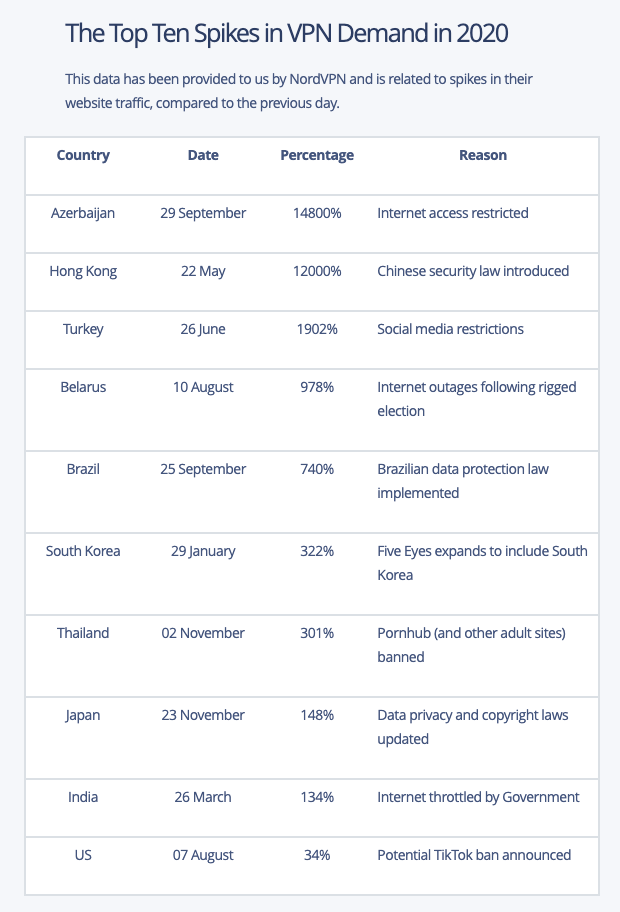
Azerbaijan ranked among the top countries where VPN services were in high demand last year between September and November during the 44-day war between Armenia and Azerbaijan. According to Proprivacy and NordVPN research “global events in 2020 have caused surges in VPN demand, as citizens from Belarus to Hong Kong set out to secure their online privacy and protect themselves from censorship and persecution for their online activities.” Azerbaijan was among the top ten countries where interest in VPN providers spiked in 2020.

Source: https://proprivacy.com/privacy-news/vpn-spikes-2020

“In late September, as the violent clashes between Azerbaijan and Armenia continued to escalate over the Nagorno-Karabakh region, the Ministry of Transport, Communications and High Technologies of Azerbaijan took action to restrict internet access across the country. Extensive social media restrictions were put in place that took down major communications services, including: Facebook, WhatsApp, YouTube, Instagram, Twitter, Zoom, Skype, Messenger,” said the joing report.

In a different report Azerbaijan was once again among the top countries where the biggest increase of VPN usage was recorded. “On September 29, NordVPN saw online privacy tool usage increased by 148 times due to internet access restrictions,” said the report. 

Not surprisingly, NordVPN, a Lithuanian by origin, was among the top targeted providers by pro-government media outlets, which said the service was owned by Armenians and therefore users in Azerbaijan should avoid using this provider.  

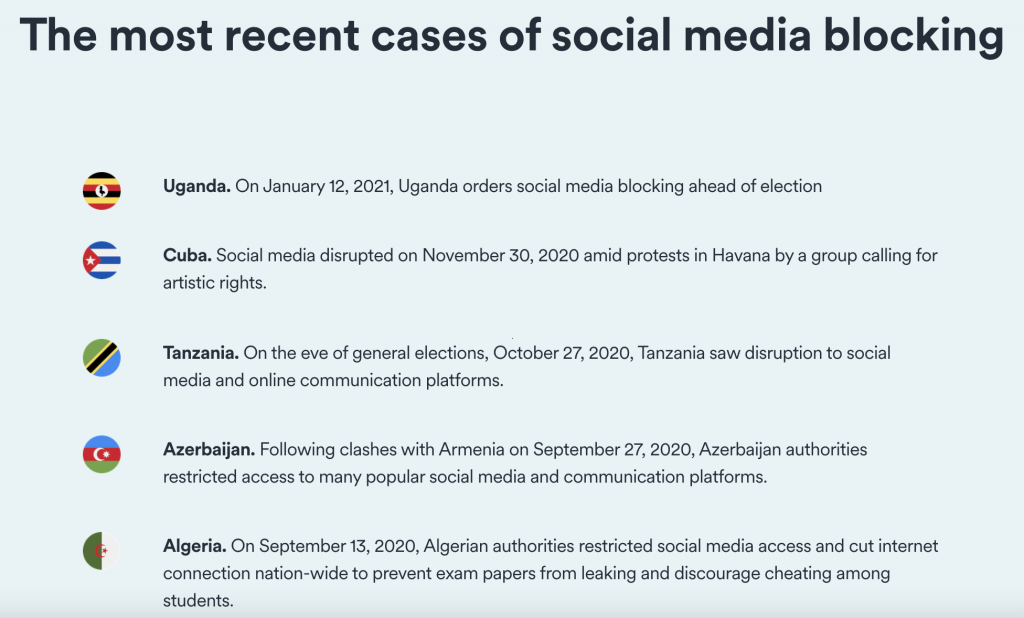
Finally, Surfshark, analyzed 185 countries and their social media blocking practices from 2015 to the present day. There Azerbaijan is ranked among the most recent cases of social media blocking [Surfshark too was discredited by Azerbaijan media outlet as being allegedly owned by Armenians, even though the company is registered in BVI. You can check out it’s ranking here.] 

Source: https://surfshark.com/social-media-blocking

On November 10 Azerbaijan and Armenia signed an agreement to end the active phase of fighting. On November 12, the government lifted the blocking and access to all social media platforms.  

For disruptions observed throughout the 44 days read this timeline. For the country ranking in Internet Freedom, you can read the most recent report on Net Freedom by Freedom House here.

Restrictive new bills sweep freedoms under the carpet [part 1]

This is part one in a series of detailed reports and analysis on existing legal amendments and new legislation affecting freedom of expression, media, and online rights in Azerbaijan and their compliance with international standards for freedom of expression.  

In March of last year, AIW shared an update about amendments to an existing bill on Information provisions, Informatization, and Protection of Information and Code of Administrative Offences of the Republic of Azerbaijan. Now, let’s take a closer look at these amendments and what they entail. 

Amendments to the Information Law

Amendments to an existing bill on Information provisions, Informatization, and Protection of Information extended the subjects – to users – of responsibilities for placement of prohibited information, including the “false information” on information-telecommunication networks.

This means that amendments establish the liability over the information-telecommunication network users to place prohibited content on the information-telecommunication networks; 

The amendments also added an item to the list of prohibited content, forbidding the  placement of false information: thus, prohibited information was considered “false information [yalan məlumatlar] in case it posed a threat to harm human life and health, cause significant property damage, mass violation of public safety, disrupt life support facilities, financial, transport, communications, industrial, energy and social infrastructure facilities or other socially dangerous consequences.”

In other words, if users placed content on the internet that might be considered false information capable to disrupt the functioning of state bodies or their activities it can be considered on the grounds of violating the existing law.

Amendments to the Code of Administrative Offences

During the same plenary meeting on March 17, 2020, an amendment to article 388-1 of the Code of Administrative Offenses (CAO) of Law No. 27-VIQD was also approved.

Article 388-1 of the CAO was aggravated with the penalty of up to one-month administrative detention with other sanctions against real or legal person owners of internet information resources and associated domain names as well as on users of information-telecommunication networks for the placement, or the violation of provisions of the Information Law aiming at preventing the placement, of prohibited information on such internet information resources.

With the amendments introduced to laws, users of the information-telecommunication network, owners of internet information resources, and domain names might be punished under Article 388-1 of the CAO. The penalty for the offense is a fine between 500 and 1000 manats (about US$294–$588) for real persons and 1000 to 1500 manats for officials, with an option of up to one month of administrative detention for both classes of persons depending on the circumstances and the identity of the offender.

Implementation of the Amendments (abuse of application)

Shortly after the amendments, police applied these provisions frequently against individuals, including political activists and journalists despite the call from the United Nations, Council of Europe, and OSCE expert bodies urging the authorities to address the disinformation in the first instance by relevant government institutions, providing reliable information and resorting to other restrictive measures, only where they met the standards of necessity and proportionality. This did not prevent authorities from targeting a number of activists and journalists in the following days.

On April 16, 2020, Human Rights Watch documented how Azerbaijani authorities abused quarantine restrictions allegedly to fight with disinformation while arresting opposition activists and silencing the government critics. HRW documented at least six activists and opposition journalists’ sentenced to detentions ranging from 10 to 30 days.

March 21, 2020, Ilgar Atayev was called in for questioning and charged with article 388.1 of the code of administrative offenses – sharing prohibited information on the Internet or Internet – telecommunication networks. According to Meydan TV, an independent online news platform, although Atayev informed that the charges against him were sent to court, he was not aware of the exact accusation. Authorities claimed at the time, Atayev, shared information on COVID without quoting official sources and that the shared information was false.

March 23, 2020, according to the Ministry of Internal Affairs’ press service, three people were administratively arrested for allegedly spreading misinformation about the coronavirus infection.

March 27, 2020, according to the Ministry of Internal Affairs’ press service, between March 26 and 27, 15 people were identified and summoned to the local police on the grounds of allegedly spreading misinformation about the coronavirus infection on social networks and WhatsApp instant messaging application. After the relevant investigations, police warned seven people, fined five, and sentenced three to administrative detention.

April 4, 2020, according to the Ministry of Internal Affairs’ press service, during the control measures carried out between April 1-2, one person was administratively arrested, and five people were fined for allegedly spreading false information about the coronavirus infection on social networks, including WhatsApp instant messaging application.

April 6, 2020, according to the Ministry of Internal Affairs’ press service, one person received a warning for allegedly spreading false information about the coronavirus infection on social networks, including WhatsApp instant messaging application.

Amid on-going arrests, detentions, and fines, on April 3, 2020, the Council of Europe Commissioner for Human Rights issued a statement noting that press freedom must not be undermined by measures to counter disinformation about COVID-19.

Analysis of the law

Content regulation rules and policies which presumably touch on the freedom of speech must meet the strict criteria under international and regional human rights law. According to the European Court of Human Rights jurisprudence, a strict three-part test is required for any content-based restriction.

The Court notes that the first and most crucial requirement of Article 10 of the Convention is that any interference by a public authority with the exercise of the freedom of expression should be lawful.

The second paragraph of Article 10 stipulates that any restriction on expression must be “prescribed by law”. Furthermore, any restrictions need to be necessary for a democratic society [See Sunday Times v. UK (No. 2), Series A no. 217, 26.11.1991, para. 50; Okçuoğlu v. Turkey, No. 24246/94, 8.7.1999, para. 43.] and the state interference should correspond to a “pressing social need”.[See Sürek v. Turkey (No. 1) (Application No. 26682/95), the judgment of 8 July 1999, Reports 1999; Sürek (No. 3) judgment of 8 July 1999.] The state response and the limitations provided by law should be “proportionate to the legitimate aim pursued” [See Bladet Tromsø and Stensaas v. Norway [GC], no. 21980/93, ECHR 1999-III.] Therefore, the necessity of the content-based restrictions must be convincingly established by the state [The Observer and The Guardian v. the United Kingdom, the judgment of 26 November 1991, Series A no. 216, pp. 29-30, § 59.]

The Law on Information, Informatisation, and Protection of Information (Law № 460-IQ)

In 2017, the Law (1998) was updated with a series of restrictive amendments, converting the Law from a technical regulation into a content regulation.

Primary concerns of the Law concerning content regulation:

Owner of the Internet information resource, including owners of the domain name, host, and internet providers bear a strict administrative liability to remove the content manifestly prohibited under article 13-2.3 within 8 hours of notice;

In urgent cases, [when the legally protected interests of the state and society are threatened or there is a real threat to human life and health requires to do] the internet information resource may be temporarily restricted on the basis of a decision of the regulatory body – Ministry of Transport, Communications and High Technologies [restriction is applied without a court order. Although an application is made to the court, the decision to close down the online information source remains in force until the court handles the case or the decision is annulled.]

In refusing to remove the content upon the government’s notice within the 9 hours, owners of internet information resources, owners of domain names, host, and internet providers will face a court sue with possible administrative sanctions.

Safeguards against removal and blocking procedures:

Article 13-3.1 of the law provides that the relevant executive authority (regulatory body) shall issue a warning to the owner of the Internet information resource and its domain name and the hosting provider in writing if it directly discovers cases of placement of prohibited information in the Internet information resource or identifies it based on substantiated information received from individuals, legal entities or government agencies;

Existing legislation and practice concerning content removal and blocking do not provide adequate safeguards against arbitrariness;

for instance, there is no requirement to inform the information resource owners, Internet and host providers or owners of other sites and their users before issuing the content removal warning, and failure to implement the warning leads to a penalty because the Code of Administrative Offenses provides for liability for both the posting of prohibited information and the failure to remove prohibited information posted on the Internet.

The Law on Information, Informatisation, and Protection of Information provide that warning about content removal is considered a mandatory requirement and that failure to obey is sanctioned under Article 388-1.1 of the CAO and possible court sue for block order.

Content removal and blocking procedures also lack transparency and fairness:

The law does not oblige the regulatory body to provide the information resource owners, internet and host providers, or other sites’ substantiated opinion reasoning for the content prohibited. In other words, the regulatory body and other state authorities can request to remove the content or block access to websites without any obligation to substantiate their demands.

Vague Terms and Quality Law Standards:

Sufficient clarity is the requirement of the quality law standard established by the ECHR case-law which requires that the law be both adequately accessible and foreseeable, that is, formulated with sufficient precision to enable the individual to foresee the consequences which a given action may entail, and indicate with sufficient clarity the scope of any discretion conferred on the competent authorities and the manner of its exercise [see Hasan and Chaush v. Bulgaria [GC], no. 30985/96, § 84, ECHR 2000‑XI; and Ahmet Yıldırım, cited above, §§ 57 and 59].

In the list of prohibited information envisaged in the Law on Information, Informatisation, and Protection of Information, the definition of what entails prohibited content is described with vague expressions that are open to excessive interpretations. With these terms, the state authorities “enjoy” a broad discretion power to categorize any information as prohibited (Law № 460-IQ). 

For instance, article 13-2.3.2 of the Law (№ 460-IQ) classifies the information on the promotion of violence and religious extremism and calls for the separation of territorial integrity as prohibited content. The religious extremism and calls for the separation of territorial integrity are vague terms and lack sufficient clarity.

The Law on Combat with Religious Extremism (LCRE) adopted in December 2015, in article 1.0.1.1 defines religious extremism with vague and problematic expressions. The Law refers to acts as “humiliating national dignity,” “compromising religion,”  and “preparing, storing and disseminating religious extremist material” as amounting to religious extremism. Expressions such as “national dignity” or “humiliation of national dignity” are non-legal concepts that are not defined in the domestic laws and therefore subject to broad interpretation by the authorities applying them, opening the way to misinterpretation of the concept and its application in an arbitrary manner [Furthermore, article 1.0.1.6 of the LCRE refers to “forcing someone to practice any religion (religious belief), including performing religious ceremonies and rituals as well as to religious education” as another act of religious extremism, which is equally problematic and may collide with the idea of spreading ideas of religious beliefs and inviting others to join, as a part of exercising freedom of religion, subject to the interpretation of the two concepts by the authorities, in absence of any criteria or clear terms in place. As the ECtHR has ruled, freedom of religion and the freedom to change religion in particular cover activities aimed at persuading others to change religion.]

Procedural safeguards:

Another problematic provision is article 13-2.3.9 of the law, which classifies insult and slander as the prohibited content online. Generally, the legislation of Azerbaijan provides for both civil action and criminal prosecution of defamation. As to the criminal prosecution of defamation, as of March 2017, there are four articles in the Criminal Code that provide criminal liability for defamation. With the amendments to the Law on Information, Informatization, and Protection of Information and Code of Administrative Offences on 17 March 2020, defamation is now sanctioned under the code of administrative offenses.

In practice, police often apply this provision against people who allegedly insult police or other state officials. 

On June 27, 2020, police arrested and fined several individuals who criticized the singers who devoted a song to the police claiming, they allegedly insulted the singers on social networks, insulted their honor and dignity. Meydan TV’s investigation revealed that most of those punished were representatives of opposition parties such as the Popular Front, Musavat and public activists. They were punished under Article 388-1 (posting of information prohibited from dissemination on the Internet).

However, the application of this provision contradicts with the domestic legislation. In Azerbaijan, it is not up to the police to classify the information on the grounds of slander or insult and instead is defined exclusively by the respective domestic courts upon the complaints of the individuals.

According to well-established court practice, courts always decide to conduct an expert examination to assess whether information/opinion is insulting or slanderous, and then the judge relies on the result of the expert examination. Furthermore, the law does not exclude the possibility that the same statement may be subject to both civil and criminal proceedings for defamation. 

Furthermore, the law does not specify how the sanction might be imposed if alleged prohibited content is identified. It is not clear from the text whether the website user will bear the responsibility alone or together with the owner of the internet or host provider. It is seemingly left to the executive authority to decide. For instance, in the case of a media article that allegedly contains prohibited content, the government may block the website forever in parallel, imposing sanctions on the content owner (user of the information resource).

Proportionate and necessary:

As discussed above, if the restriction does not meet proportionality and necessity requirements, the content removal or blocking measures may lead to violation of freedom of expression guaranteed under article 10 of the European Convention on Human Rights. Law on Information, Informatisation, and Protection of Information fail to specify a definition of the categories of blocking orders, such as blocking of entire websites, Internet Protocol (IP) addresses, ports, network protocols or types of use, like social networking, including a limit on the duration of the blocking order which is crucial parameters of the interference to assess whether applied methods are proportionate and necessary in a democratic society to limit the freedom of expression.

Conclusion

This ambiguous law gives extensive flexibility for the state to consider different, particularly critical views as false and government views as correct. The new amendments stipulate that the information shared on the Internet, which disrupts activities of the state institutions, is prohibited and punishable under the Code of Administrative Offences. While false information is also prohibited and punishable if such information threatens other socially dangerous consequences, which the law does not define. 

Such vague definitions and ambiguous expressions provide extensive discretion powers for the state authorities, allowing them to label critical views as false and prohibited. Given the abovementioned concerns, the Law on Information, Informatisation, and Protection of Information does not comply with international standards on freedom of expression. Its scope remains incredibly broad in terms of vague definitions, lack of safeguards, and procedural guarantees.


Journalist questioned over alleged extortion charges

December 14, freelance journalist Nurlan Gahramanli (Libre) reported being questioned at the Baku City Main Police Department over alleged extortion charges. But Gahramanli refutes the claims and believes, the reason for his persecution is his live coverage of Victory Day protests on December 10 that he did over Facebook

“A police officer named Fuad Babayev invited me to the bureau. He told me that I have allegedly blackmailed a man named Tabriz Ahliyarli via ‘Orange Media’ Instagram account in November [the account previously managed by Gahramanli, but which he no longer has access to according to Gahramanli himself]. I told him, I never heard of the name,” the journalist told Meydan TV. Gahramanli does not rule out that the allegation of blackmail and extortion is the work of the Organized Crime department that detained and questioned Gahramanli on October 30. During his detention, his phone was confiscated and the department had access to it. Gahramanli believes it is possible that the department employees established contact with Tabriz Ahliyarli using Gahramanli’s ‘Orange Media’ Instagram account to later blackmail Gahramanli and use it as proof that indeed he has made contact with the alleged victim.

“During the questioning by Fuad Babayev, I was threatened with a criminal case and imprisonment,” Gahramanli told Meydan TV. 

The journalist publicized his visit to the Organized Crime Unit via various online news platforms. The following day the Ministry of the Interior called him and told him his phone was under surveillance and that if I continue my journalist work, persecution will continue and that I will be arrested.”

Meanwhile, the Ministry of the Interior has refuted Gahramanli’s claim that he was beaten during his detention at the Organized Crime Unit. Instead, the ministry said in an official statement that Gahramanli received a warning from the relevant authorities, following a series of complaints by “many citizens” who have informed the Ministry of the Interior, Gahramanli made contacts and befriended Armenians on social platforms, liked and shared their public posts critical of Azerbaijan. “Nurlan Gahramanli was invited to the police following these appeals and after getting his statement, he was given a warning and released. Gahramanli’s claims that he is being prosecuted by the authorities are baseless,” said the statement.   

Azerbaijan September – November 2020 OONI Measurement Results

On September 27, the government in Azerbaijan introduced a series of restrictions on Internet access as a result of military operations in Nagorno Karabakh. Users in Azerbaijan were left with limited Internet access while access to a number of social media platforms, as well as communication apps, were restricted. 

Azerbaijan Internet Watch, and OONI collected data based on OONI measurements from Azerbaijan. Below is the report looking at data between September 2020 to November 2020. 

According to collected OONI data, Azerbaijan experienced the blocking of independent media websites as well as signs of potential circumvention tool site blocking. However, further OONI Prote testing is required to confirm these censorship events. Azerbaijan Internet Watch continues to monitor the situation. 

Starting on September 27, a number of social media services indicated signs of blocking in Azerbaijan. Among these were:

Whatsapp: between 27th September 2020 to 11th November 2020 , all OONI Probe WhatsApp tests showed signs of WhatsApp blocking. This is illustrated through OONI Probe WhatsApp measurements collected from multiple local networks in Azerbaijan. Previously according to the same measurements, no such instances were documented. The measurements indicated that attempted connections to WhatsApp’s registration service and web interface (web.whatsapp.com) failed. In some cases HTTP request to web.whatsapp.com succeeded while HTTPS request failed as illustrated below. 

This could be an indication of SNI based filtering of WhatsApp. We also observe that the tls_handshakes field presented failures, further suggesting that access to WhatsApp was blocked in Azerbaijan by means of SNI based filtering.

This pattern was seen across multiple ISPs in Azerbaijan between 27th September 2020 to 11th November 2020.

Telegram: Similarly to the testing of WhatsApp, OONI measurements presented signs of Telegram blocking in Azerbaijan between 27th September 2020 to 11th November 2020. But unlike WhatsApp, a few Telegram tests during this period were successful. This is illustrated through OONI Probe Telegram measurements collected from multiple local networks in Azerbaijan between 1st September 2020 to 27th November 2020. The following table illustrates OONI measurements collected from the testing of Telegram and WhatsApp on 5 different networks in Azerbaijan between September 2020 to November 2020.

We not only observed similarities between the date range of potential blocking (of WhatsApp and Telegram), but we also saw potentially similar censorship techniques, as the HTTP requests to Telegram Web (web.telegram.org) timed out as well. Similarly to WhatsApp, we observed a timeout in the TLS handshake, suggesting TLS level interference of Telegram as well. As a result, it is possible that internet users in Azerbaijan couldn’t use the Telegram and WhatsApp mobile apps (on the tested networks) during this time period (between 27th September 2020 to 11th November 2020), even though connections to the tested app endpoints succeeded.

Social media sites: apart from WhatsApp and Telegram, several social media websites presented signs of blocking as well, starting from early October 2020. These include:

It is however, important to note these sites’ limited testing coverage limits Azerbaijan Internet Watch and OONI’s confidence with respect to their blocking, and they have not been tested more recently especially after the conflict ended.

AIW and OONI continue monitoring the situation with blocking.

Azerbaijan not free in Freedom on the Net annual report

Azerbaijan ranked “not free” in this year’s Freedom House, Freedom on the Net report. Among key factors are the overall infrastructural challenges, a monopoly over ISPs, and distributed Internet traffic, state control over the information and communication technology, blocked access to most websites that host unfavorable news coverage, and new forms of restrictions introduced during COVID-19. 

According to the report, there is an overall decline in internet freedoms across the world:

Global internet freedom has declined for the 10th consecutive year: 26 countries’ scores worsened during this year’s coverage period, while 22 countries registered net gains. The largest declines occurred in Myanmar and Kyrgyzstan, followed by IndiaEcuador, and Nigeria. A record number of countries featured deliberate disruptions to internet service.

On the bright side, countries like Sudan and Ukraine experienced the largest improvements, followed by Zimbabwe find the report. And while Iceland was the top performer China was found to have the worst conditions for internet freedom. 

The report highlighted some new trends that have emerged globally: 

[…] this year Freedom on the Net observed intentional disruptions to connectivity in a record 22 out of 65 countries. Many of these disruptions, including Iran’s November 2019 countrywide blackout and shutdowns in Moscow in August and September 2019, were directly precipitated by protests. Such practices are an ultimate expression of contempt for freedoms of association and assembly, as well as for the right to access information.

Azerbaijan was ranked partly free last year. 

peace activists targeted online [updated]

Since the war over Nagorno Karabakh began on September 27, scores of peace activists in Azerbaijan have been targeted both online and offline for their views. From public Facebook posts and pages targeting the activists, with threats of violence and physical harm, calls for public shaming and punishment, to questioning at Security Services, this has no doubt been one of the harshest, collective, online public harassment campaigns observed until now in Azerbaijan.

On September 30, an anti-war statement signed by a group of Azerbaijani leftists was published online. Another anti-war statement was published shortly after by an online regional platform Caucasus Talks. In a matter of days, many Azerbaijani activists who signed the statements began receiving online threats, harassment, and deliberate targeting.

A Facebook page called Pinochet Airlines [which was successfully removed after reporting the page to Facebook] was sharing pictures of Azerbaijani signatories, using foul language, humiliating, and calling for public action against them. After the page was taken down, a user, who claimed to allegedly run the page, said in a Facebook post the page lived up to its purpose and although it was taken down, more was yet to come.

Caucasus Talks platform was smeared with allegations to have links to the Armenian Prime Minister’s wife. These allegations were refuted by the platform in a series of tweets:

On Twitter, some users called for the execution of #nowar activists.

In addition to online targeting, some of the activists were called into questioning at State Security Services over their views shared online on several occasions. Most recently, Latif Mammadov was called for questioning on November 16 where he was threatened for his online activities. “One of them asked me a question and when he didn’t like my answer he grabbed me by the collar and just started shaking me vigorously, I pushed him on his shoulder so he let me go, but then his colleague got up and they pushed me down on the chair […] They said they will kill me and my parents if I don’t stop [my online activity],” Mammadov told OC Media in an interview. 

Online and offline harassments and targeting are common in Azerbaijan, especially when targeting high profile political activists and figures. However, this time, deliberate, coordinated targeting against a handful of peace activists and no war advocates, is clearly linked to the nationalist fervor stemming from the on-going fighting between Armenia and Azerbaijan, that ended on November 10 with a deal brokered by Russia. 

spotted: sandvine back at it, this time, in Azerbaijan

In August, when people in Belarus took the streets across the country in protest of election results where incumbent President Lukashenka secured yet another victory in a contested presidential election, authorities deliberately cut the internet. Quickly, experts concluded DPI technology may be in use. By the end of August, it was reported that this DPI technology was produced by the Canadian company Sandvine and supplied to Belarus as part of a $2.5million contract with the Russian technology supplies Jet Infosystems.

DPI (Deep Packet Inspection) is known as digital eavesdropping that allows information extraction. More broadly as explained here, DPI “is a method of monitoring and filtering internet traffic through inspecting the contents of each packet that is transmitted through an inspection point, allowing for filtering out malware and unwanted traffic, but also real-time monitoring of communications, as well as the implementation of targeted blockings and shutdowns.” 

Canadian company Sandvine is owned by American private equity firm Francisco Partners.


Sandvine technology has been detected in many countries across the world, including in Ethiopia, Iran, as well as Turkey, and Syria as previously reported. One other country where Sandvine technology was reportedly deployed is Azerbaijan

In Azerbaijan, the DPI deployments have been used since March 2017. This was reported in January 2019, when VirtualRoad, the secure hosting project of the Qurium – Media Foundation published a report documenting fresh attacks against Azerbaijan’s oldest opposition newspaper Azadliq’s website (azadliq.info). The report concluded: “After ten months trying to keep azadliq.info online inside Azerbaijan using our Bifrost service and bypassing multi-million dollar DPI deployments, this is one more sign of to what extent a government is committed to information control”.  

Another report released in April 2018 showed evidence of the government of Azerbaijan using Deep Packet Inspection (DPI) since March 2017. The report also found out that this specialized security equipment was purchased at a price tag of 3 million USD from an Israeli security company Allot Communications.

Now, according to this story reported by Bloomberg, Sandvine worked with Delta Telecom – Azerbaijan’s main internet provider and owned by the government to install a system to block live stream videos from YouTube, Facebook, and Instagram. “The social media blackout came last week after deadly clashes with Armenia. As a result, people in Azerbaijan couldn’t reach websites including Facebook, WhatsApp, YouTube, Instagram, TikTok, LinkedIn, Twitter, Zoom, and Skype, according to internet monitoring organization Netblocks,” wrote Bloomberg. 

Azerbaijan Internet Watch has been monitoring the situation on the ground since September 27, the day when clashes began. Together with OONI, Azerbaijan Internet Watch reported that access to several social media applications and websites was blocked. 

Access to the Internet remains throttled in Azerbaijan as of writing this post. Many of the social media applications remain accessible only through a VPN provider. As a result, authorities have resorted to other means in order to prevent users from using VPN services. From banks to ISPs encouraging users not to use VPN services, this account on Facebook made a list of VPNs alleging they were of Armenian origin in order to discourage users.

country-wide internet disruptions reported in Azerbaijan [updated]

[UPDATE] On November 12, access to the Internet was finally restored across the country in Azerbaijan. This was shared in an announcement shared by the Ministry of Communication, Transportation and High Technologies on November 11. In a statement, the Ministry said:

The temporary restriction on Internet access imposed in our country in order to prevent large-scale provocations and cyber incidents committed by the Republic of Armenia will be lifted on November 12, 2020, with the exception of the territories liberated from occupation and former frontier zones.

The Ministry expresses gratitude to millions of Azerbaijani Internet users for their understanding in connection with the restriction on Internet access over the past period.

It should be noted that the Ministry of Transport, Communications and High Technologies imposed restrictions on the provision of Internet in the country on September 27, 2020.

ABC.az, a local online news platform, reported that restrictions remained in territories liberated from occupation and territories that previously belonged to the frontline zone.

November 11, the Cabinet of Ministers said it had no information about the lifting of restrictions on Internet access in the country while addressing Turan News Agency. Meanwhile, the head of an opposition Popular Front party Ali Karimli called for an immediate end to restrictions imposed on Internet access and to social media platforms. Unlike Karimli, the head of Azerbaijan Internet Forum, Osman Gunduz, sees gradual transition as an alternative. “Although the military operations are over, keeping restrictions imposed on social media platforms is needed.” Gunduz suggested keeping restrictions on WhatsApp and YouTube as these were two of the most popular platforms where false information about the fighting made rounds. In contrast, the head of the Internet Forum, it would be suitable to lift the ban on Twitter because this platform is widely used to disseminate information about the war to an international audience. Gunduz said similar restrictions are common practice across countries including in Europe and the UK where governments restricted internet access during mass protests. “In the UK, during acts of terrorism, the government restricted access to social media platforms.” Azerbaijan Internet Watch, could not verify this statement. Unlike Azerbaijan, the UK is ranked “free” in Freedom on the Net ranking by Freedom House. Similarly, most of the European countries, are categorized under “little or no censorship, and surveillance” countries.   

As of November 7, access to the Internet remained limited with users of state operators Baktelecom and Aztelekom remaining largely disconnected or with slower than usual internet speed. The rest of the providers worked in a limited capacity while access to social media platforms remained blocked. 

October 21, President Ilham Aliyev in an interview with the Japanese Nikkei newspaper said restrictions on Internet access and on the use of social media platforms in Azerbaijan are only temporary. “Once active fighting is over we will restore all access.”  

October 20, State Security Service encouraged Azerbaijani citizens to refrain from using VPN providers when trying to access social media platforms that have been inaccessible as a result of the restrictions imposed by the government. It warned that some of the VPN providers such as SkyVPN is not trusted and can steal persona information. To its credit, the SSS is correct about the poor quality of this specific VPN service.

October 13, on the 16th day of escalated tensions between Armenia and Azerbaijan, Internet access remains throttled in Azerbaijan. The Ministry of Transportation, Communication and High Technologies claims throttling is in line with government orders given the active state of military operations. But not to everyone. Independent media and journalists complain they have had issues posting news since the start of the recent conflict on September 27 on their websites and social media accounts. In addition to slowing down the Internet, on October 8, a story reported by Bloomberg identified the use of Deep Packet Inspection (DPI) technology in Azerbaijan to effectively block access to many of the social media platforms in the country as well. However, this is not the case for government news outlets and government institutions. The latter’s access to uninterrupted and undisrupted Internet highlights the inequality of access to information both by those who produce independent news as well as the audience of these platforms. Experts say that blocking specific content may align with the existing legal framework, however, throttling access to the Internet altogether is a violation of user rights.

October 10, while the spokesperson for the Ministry of Transportation, Communication and High Technologies, Gunel Gozalova said in a statement to Report.az, that the ministry remains uncertain about the duration of the government imposed internet limitations, independent economy expert Togrul Mashalli, has raised the issue of the economic costs, the recent internet disruptions are posting. Writing through his personal Telegram channel, Mashalli wrote, “it is not just the social media platforms that are limited, but other services too. And this is happening across the whole country. According to the Netblocks Cost of Shutdown Tool, Azerbaijan’s economy is suffering from a total of 44.8millionUSD loss per day. So over the 13 days, this adds up to a 582,4million USD. Since the Internet has not fully been turned off, the total losses are probably around 200-250million USD (we should take into account that social media platforms are often an important part of local internet economy).”

October 9, Gunel Gozalova, spokesperson for the Ministry of Transportation, Communication and High Technologies, said, the government has not shut down the internet. “We have only restricted the Internet. So no one can say, there is no internet at all […] The restrictions introduced are simply to prevent unwanted, unverified, war-related content on social networks. We have taken these measures to protect Azerbaijan’s positions in cyberspace.” The spokesperson said, she does not have any information about how long these restrictions will last. Other experts as the head of Azerbaijan Internet Forum, Osman Gunduz said, the restrictions should be taken with an understanding: “it is possible that we don’t have access to certain information and we can’t analyze what is happening as a result. We think if social media platforms and the internet remained completely open to access it would have been better. But this is not the case. It is normal that given the military situation this step was taken. This is legal. However, I am for having additional measures in place especially for those wanting to fight anti-Azerbaijan propaganda online. It is necessary to set up centers and create a suitable environment for media, experts, and others who have experience working in an international environment.”

October 8, ABC.az local online news platform released a list of VPN providers claiming they were allegedly Armenian providers. The list includes the following VPN services: Express VPN, Nord VPN, VPN 360, CyberGhost VPN, HMA Vpn, Surfshark VPN. While finding the right VPN provider is often challenging, and some of the listed companies do have murky ownership presenting these services as Armenian owned is inaccurate and misleading. Instead, ABC.az could have offered this source for comparisons of numerous VPN services.  

October 3, a number of mobile operators came forward refuting claims of limiting access to users relying on VPN services from their devices.  Nar mobile said they have not introduced any additional limitations to their users relying on VPN services, adding that within the recently introduced internet restrictions and for the sake of protecting their users’ information, users of the mobile operator may face restrictions while accessing “Nar+” application and “nar.az” website. “Information on your mobile devices, as well as passwords used for other applications can be stolen by third parties when using VPN applications. We call on our subscribers to protect their security and advice against the use of VPN applications,” said the mobile operator in an interview with MediaPost. 

Another mobile operator Bakcell, said, no extra restrictions were applied by the operator. The company did however encourage its clients to resort to the Ministry of Transportation, Communication and High Technologies on rules and recommendations about the use VPN services. “Given the current environment, citizens should accept the circumstances with an understanding and follow cyber security rules. It is also important, to pay attention to the origins and trustworthiness of the applications in use.”

Azercell Telekom said it bears no responsibility over its users devices, as well as their security and that it only provides its clients with internet connection within the scope of its telecom services, which include access to social media platforms and websites. 

October 1, Government in Azerbaijan continues to pose limitations to Internet access as tensions continue on the front line. Joining them are internet providers and telecom companies. According to Azerbaijan Press Agency (APA), Azerfon mobile company (with alleged ties to the ruling family) told its users, that its website and the mobile application won’t be accessible for users, using VPN. At the time of writing this update, the website was inaccessible from abroad, without a VPN.  

September 30, according to the most recent reports Internet access remains throttled in Azerbaijan. Users report: 

  • Bakinternet (ISP)- not working
  • Access to social media platforms not possible without a VPN;
  • Whatsapp app and its web extension are not working (without a VPN); 
  • WiFi connections are down for some; 
  • Internet speed is slow; 
  • Gmail is accessible without a VPN; 
  • Some banks [ex. Rabitabank] has informed its customers their mobile app won’t be accessible if users have VPN active; 
  • Bakcell [mobile operator] and Kapitalbank mobile apps are not accessible when VPN is used;

On its website, Bakinternet (an ISP for Bak Telecom) shared a similar statement seen earlier on the website of the Ministry of Transportation, Communication and High Technologies: “In order to prevent provocations from Armenia, access to the Internet has been limited.” 

Translation: 

Employees are asked to delete VPN apps at the workplaces;
They are told using VPN is dangerous;
AzerTac (state news agency) published articles and aired TV shows discussing the dangers of VPN;

According to the VPN service Surfshark website, the sale of VPN in Azerbaijan witnessed a sharp increase as the country moved to block social media platforms starting September 27. “An increased number of Azerbaijanis are turning to Surfshark VPN, leading to an ongoing spike in sales. As a VPN service, Surfshark allows users to overcome government blockades. It doesn’t matter if the new restrictions are imposed via a relatively simple DNS-level block or a sophisticated deep packet inspection, a VPN can open access to blocked media.”

As users in Azerbaijan began increasingly reliant on VPN providers rumors of imposed fines against those who are accessing the blocked content began circulating online. However, the Ministry of Transportation, Communication and High Technologies said, this was not true and that the government body, cannot impose fines. There is also no such legislation in Azerbaijan on the use of VPNs. Instead, the ministry representative encouraged Azerbaijani users, to rely on government media, and stop looking for news on social networks.  


September 29, as clashes on the front line continued on the third day, Internet access in Azerbaijan remained spotty. Users continued reporting difficulties accessing social media platforms. Access to government websites remained spotty. The Ministry of Transportation, Communication and High Technologies did not share any further updates on how much longer the situation will last. 


September 28, according to the most recent reports from Azerbaijan, users continued to face difficulties accessing social media platforms unless using VPN services. 

Government websites that were mostly inaccessible yesterday were restored.

The Ministry of Transportation, Communication and High Technologies (MCHT) has not made any further statements about the duration of currently imposed throttling. 

Instead, MCHT did issue a warning to users of VPN services in the country with the caveat they were unsafe, collecting private user information, and also capable of infecting devices with malware. The Ministry failed to mention the amount of surveillance technology used by other government institutions against citizens in Azerbaijan. 

***

Based on OONI Measurement results it was possible to confirm that the following applications were blocked in Azerbaijan:

According to measurements, the Facebook messenger app was reachable

Similarly, according to measurements access to the Telegram app was available on some networks. 


As tensions between Armenia and Azerbaijan escalated on the front line on September 27, Internet users in Azerbaijan began reporting issues accessing the Internet, social media platforms (Facebook, Instagram, YouTube, and others), and communication apps (WhatsApp, Telegram).

Translation: Looks like they are only limiting access to social media platforms. There are no problems when accessing the Internet [sites]. It is possible to access other websites. 

Issues accessing the internet began already a day before.

Azərbaycandakı internet istifadəçiləri ölkədəki internetin surətindən şikayət edirlər. Bir çoxu xeyli yavaşladığını, foto və videoların açılmadığını deyirlər. Sizdə vəziyyət necədir?

Posted by Hebib Müntezir on Saturday, September 26, 2020

Translation: In Azerbaijan, internet users are complaining about internet speed. Many are saying its slowed down, having difficulties loading videos and images. What is the situation on your end?

Throughout the day, users continued reporting issues with access, speed and lack of information on how much longer the limits on access will continue.

At around 10 AM local time, the Ministry of Transportation, Communication, and High Technologies issued a statement in which it claimed the Ministry was behind internet disruptions.

Ministry of Transportation, Communication and High Technologies Screenshot

At some point, all websites with gov.az extension were down.

All .gov.az also websites are down including https://t.co/DbfCTYL84y and https://t.co/WJUKYKdrQR https://t.co/N20cYTu7c4

— Cavid ⛧ (@cavidaga) September 27, 2020

According to a global #KeepItOn campaign, “Public safety, national security, or stopping fake news are commonly used to justify shutdowns.” Looking at data collected as a result of the campaign there is a significant annual growth in the number of shutdowns reported across the world. Last year alone, 1706 days of internet access were disrupted by 213 internet shutdowns across 33 countries according to #KeepItOn campaign. 

Internet disruptions of various forms and scale in Azerbaijan are not new. Since April, a leader of an opposition party has had his internet cut off. Sometimes they are reportedly caused as a result of technical incidents. In other cases, access to internet is intentionally slowed down especially around political events. 

While some users online commented on internet disruptions as necessary measure to prevent spread of unconfirmed information, others argued the decision to simply throttle the connection was an easy solution especially when there is no way, the authorities can control social media platforms. 

Azerbaijan Internet Watch continues to monitor developments on the ground.