Azerbaijan ranked “not free” in this year’s Freedom House, Freedom on the Net report. Among key factors are the overall infrastructural challenges, a monopoly over ISPs, and distributed Internet traffic, state control over the information and communication technology, blocked access to most websites that host unfavorable news coverage, and new forms of restrictions introduced during COVID-19.
According to the report, there is an overall decline in internet freedoms across the world:
Global internet freedom has declined for the 10th consecutive year: 26 countries’ scores worsened during this year’s coverage period, while 22 countries registered net gains. The largest declines occurred in Myanmar and Kyrgyzstan, followed by India, Ecuador, and Nigeria. A record number of countries featured deliberate disruptions to internet service.
On the bright side, countries like Sudan and Ukraine experienced the largest improvements, followed by Zimbabwe find the report. And while Iceland was the top performer China was found to have the worst conditions for internet freedom.
The report highlighted some new trends that have emerged globally:
[…] this year Freedom on the Net observed intentional disruptions to connectivity in a record 22 out of 65 countries. Many of these disruptions, including Iran’s November 2019 countrywide blackout and shutdowns in Moscow in August and September 2019, were directly precipitated by protests. Such practices are an ultimate expression of contempt for freedoms of association and assembly, as well as for the right to access information.
Since the war over Nagorno Karabakh began on September 27, scores of peace activists in Azerbaijan have been targeted both online and offline for their views. From public Facebook posts and pages targeting the activists, with threats of violence and physical harm, calls for public shaming and punishment, to questioning at Security Services, this has no doubt been one of the harshest, collective, online public harassment campaigns observed until now in Azerbaijan.
On September 30, an anti-war statement signed by a group of Azerbaijani leftists was published online. Another anti-war statement was published shortly after by an online regional platform Caucasus Talks. In a matter of days, many Azerbaijani activists who signed the statements began receiving online threats, harassment, and deliberate targeting.
A Facebook page called Pinochet Airlines [which was successfully removed after reporting the page to Facebook] was sharing pictures of Azerbaijani signatories, using foul language, humiliating, and calling for public action against them. After the page was taken down, a user, who claimed to allegedly run the page, said in a Facebook post the page lived up to its purpose and although it was taken down, more was yet to come.
Caucasus Talks platform was smeared with allegations to have links to the Armenian Prime Minister’s wife. These allegations were refuted by the platform in a series of tweets:
Azərbaycanca⬇️ 1/ Dear followers, there is currently a disinformation campaign spreading in Azerbaijan claiming that our platform is linked to the Armenian PM’s wife, Anna Hakobyan. We have absolutely no links to Mrs. Hakobyan.
On Twitter, some users called for the execution of #nowar activists.
In addition to online targeting, some of the activists were called into questioning at State Security Services over their views shared online on severaloccasions. Most recently, Latif Mammadov was called for questioning on November 16 where he was threatened for his online activities. “One of them asked me a question and when he didn’t like my answer he grabbed me by the collar and just started shaking me vigorously, I pushed him on his shoulder so he let me go, but then his colleague got up and they pushed me down on the chair […] They said they will kill me and my parents if I don’t stop [my online activity],” Mammadov told OC Media in an interview.
Online and offline harassments and targeting are common in Azerbaijan, especially when targeting high profile political activists and figures. However, this time, deliberate, coordinated targeting against a handful of peace activists and no war advocates, is clearly linked to the nationalist fervor stemming from the on-going fighting between Armenia and Azerbaijan, that ended on November 10 with a deal brokered by Russia.
In August, when people in Belarus took the streets across the country in protest of election results where incumbent President Lukashenka secured yet another victory in a contested presidential election, authorities deliberately cut the internet. Quickly, experts concluded DPI technology may be in use. By the end of August, it was reported that this DPI technology was produced by the Canadian company Sandvine and supplied to Belarus as part of a $2.5million contract with the Russian technology supplies Jet Infosystems.
DPI (Deep Packet Inspection) is known as digital eavesdropping that allows information extraction. More broadly as explained here, DPI “is a method of monitoring and filtering internet traffic through inspecting the contents of each packet that is transmitted through an inspection point, allowing for filtering out malware and unwanted traffic, but also real-time monitoring of communications, as well as the implementation of targeted blockings and shutdowns.”
Canadian company Sandvine is owned by American private equity firm Francisco Partners.
Sandvine technology has been detected in many countries across the world, including in Ethiopia, Iran, as well as Turkey, and Syria as previously reported. One other country where Sandvine technology was reportedly deployed is Azerbaijan.
In Azerbaijan, the DPI deployments have been used since March 2017. This was reported in January 2019, when VirtualRoad, the secure hosting project of the Qurium – Media Foundation published a report documenting fresh attacks against Azerbaijan’s oldest opposition newspaper Azadliq’s website (azadliq.info). The report concluded: “After ten months trying to keep azadliq.info online inside Azerbaijan using our Bifrost service and bypassing multi-million dollar DPI deployments, this is one more sign of to what extent a government is committed to information control”.
Another report released in April 2018 showed evidence of the government of Azerbaijan using Deep Packet Inspection (DPI) since March 2017. The report also found out that this specialized security equipment was purchased at a price tag of 3 million USD from an Israeli security company Allot Communications.
Now, according to this story reported by Bloomberg, Sandvine worked with Delta Telecom – Azerbaijan’s main internet provider and owned by the government to install a system to block live stream videos from YouTube, Facebook, and Instagram. “The social media blackout came last week after deadly clashes with Armenia. As a result, people in Azerbaijan couldn’t reach websites including Facebook, WhatsApp, YouTube, Instagram, TikTok, LinkedIn, Twitter, Zoom, and Skype, according to internet monitoring organization Netblocks,” wrote Bloomberg.
Azerbaijan Internet Watch has been monitoring the situation on the ground since September 27, the day when clashes began. Together with OONI, Azerbaijan Internet Watch reported that access to several social media applications and websites was blocked.
Access to the Internet remains throttled in Azerbaijan as of writing this post. Many of the social media applications remain accessible only through a VPN provider. As a result, authorities have resorted to other means in order to prevent users from using VPN services. From banks to ISPs encouraging users not to use VPN services, this account on Facebook made a list of VPNs alleging they were of Armenian origin in order to discourage users.
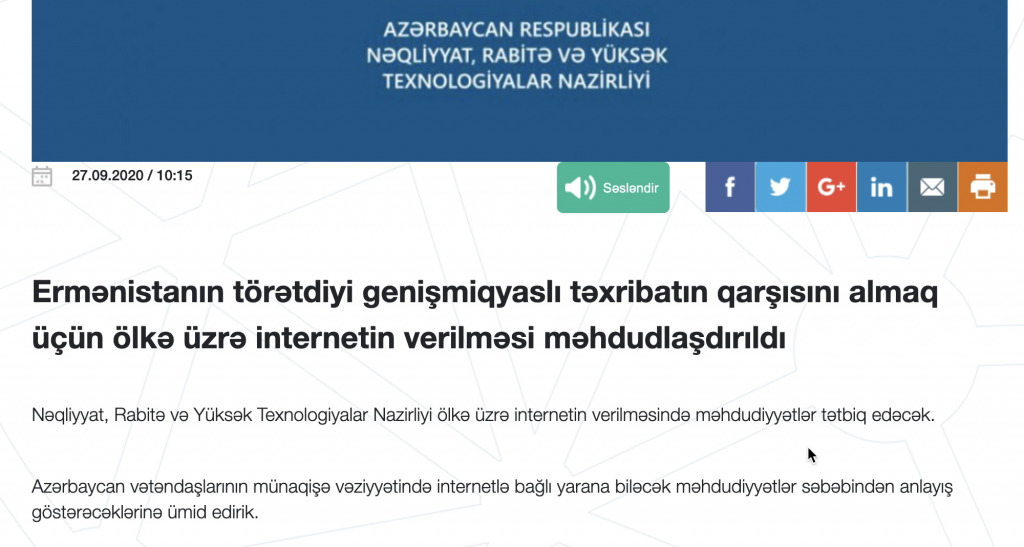
[UPDATE] On November 12, access to the Internet was finally restored across the country in Azerbaijan. This was shared in an announcement shared by the Ministry of Communication, Transportation and High Technologies on November 11. In a statement, the Ministry said:
The temporary restriction on Internet access imposed in our country in order to prevent large-scale provocations and cyber incidents committed by the Republic of Armenia will be lifted on November 12, 2020, with the exception of the territories liberated from occupation and former frontier zones.
The Ministry expresses gratitude to millions of Azerbaijani Internet users for their understanding in connection with the restriction on Internet access over the past period.
It should be noted that the Ministry of Transport, Communications and High Technologies imposed restrictions on the provision of Internet in the country on September 27, 2020.
ABC.az, a local online news platform, reported that restrictions remained in territories liberated from occupation and territories that previously belonged to the frontline zone.
November 11, the Cabinet of Ministers said it had no information about the lifting of restrictions on Internet access in the country while addressing Turan News Agency. Meanwhile, the head of an opposition Popular Front party Ali Karimli called for an immediate end to restrictions imposed on Internet access and to social media platforms. Unlike Karimli, the head of Azerbaijan Internet Forum, Osman Gunduz, sees gradual transition as an alternative. “Although the military operations are over, keeping restrictions imposed on social media platforms is needed.” Gunduz suggested keeping restrictions on WhatsApp and YouTube as these were two of the most popular platforms where false information about the fighting made rounds. In contrast, the head of the Internet Forum, it would be suitable to lift the ban on Twitter because this platform is widely used to disseminate information about the war to an international audience. Gunduz said similar restrictions are common practice across countries including in Europe and the UK where governments restricted internet access during mass protests. “In the UK, during acts of terrorism, the government restricted access to social media platforms.” Azerbaijan Internet Watch, could not verify this statement. Unlike Azerbaijan, the UK is ranked “free” in Freedom on the Net ranking by Freedom House. Similarly, most of the European countries, are categorized under “little or no censorship, and surveillance” countries.
As of November 7, access to the Internet remained limited with users of state operators Baktelecom and Aztelekom remaining largely disconnected or with slower than usual internet speed. The rest of the providers worked in a limited capacity while access to social media platforms remained blocked.
October 21, President Ilham Aliyev in an interview with the Japanese Nikkei newspaper said restrictions on Internet access and on the use of social media platforms in Azerbaijan are only temporary. “Once active fighting is over we will restore all access.”
October 20, State Security Service encouraged Azerbaijani citizens to refrain from using VPN providers when trying to access social media platforms that have been inaccessible as a result of the restrictions imposed by the government. It warned that some of the VPN providers such as SkyVPN is not trusted and can steal persona information. To its credit, the SSS is correct about the poor quality of this specific VPN service.
October 13, on the 16th day of escalated tensions between Armenia and Azerbaijan, Internet access remains throttled in Azerbaijan. The Ministry of Transportation, Communication and High Technologies claims throttling is in line with government orders given the active state of military operations. But not to everyone. Independent media and journalists complain they have had issues posting news since the start of the recent conflict on September 27 on their websites and social media accounts. In addition to slowing down the Internet, on October 8, a story reported by Bloomberg identified the use of Deep Packet Inspection (DPI) technology in Azerbaijan to effectively block access to many of the social media platforms in the country as well. However, this is not the case for government news outlets and government institutions. The latter’s access to uninterrupted and undisrupted Internet highlights the inequality of access to information both by those who produce independent news as well as the audience of these platforms. Experts say that blocking specific content may align with the existing legal framework, however, throttling access to the Internet altogether is a violation of user rights.
October 10, while the spokesperson for the Ministry of Transportation, Communication and High Technologies, Gunel Gozalova said in a statement to Report.az, that the ministry remains uncertain about the duration of the government imposed internet limitations, independent economy expert Togrul Mashalli, has raised the issue of the economic costs, the recent internet disruptions are posting. Writing through his personal Telegram channel, Mashalli wrote, “it is not just the social media platforms that are limited, but other services too. And this is happening across the whole country. According to the Netblocks Cost of Shutdown Tool, Azerbaijan’s economy is suffering from a total of 44.8millionUSD loss per day. So over the 13 days, this adds up to a 582,4million USD. Since the Internet has not fully been turned off, the total losses are probably around 200-250million USD (we should take into account that social media platforms are often an important part of local internet economy).”
October 9, Gunel Gozalova, spokesperson for the Ministry of Transportation, Communication and High Technologies, said, the government has not shut down the internet. “We have only restricted the Internet. So no one can say, there is no internet at all […] The restrictions introduced are simply to prevent unwanted, unverified, war-related content on social networks. We have taken these measures to protect Azerbaijan’s positions in cyberspace.” The spokesperson said, she does not have any information about how long these restrictions will last. Other experts as the head of Azerbaijan Internet Forum, Osman Gunduz said, the restrictions should be taken with an understanding: “it is possible that we don’t have access to certain information and we can’t analyze what is happening as a result. We think if social media platforms and the internet remained completely open to access it would have been better. But this is not the case. It is normal that given the military situation this step was taken. This is legal. However, I am for having additional measures in place especially for those wanting to fight anti-Azerbaijan propaganda online. It is necessary to set up centers and create a suitable environment for media, experts, and others who have experience working in an international environment.”
October 8, ABC.az local online news platform released a list of VPN providers claiming they were allegedly Armenian providers. The list includes the following VPN services: Express VPN, Nord VPN, VPN 360, CyberGhost VPN, HMA Vpn, Surfshark VPN. While finding the right VPN provider is often challenging, and some of the listed companies do have murky ownership presenting these services as Armenian owned is inaccurate and misleading. Instead, ABC.az could have offered this source for comparisons of numerous VPN services.
October 3, a number of mobile operators came forward refuting claims of limiting access to users relying on VPN services from their devices. Nar mobile said they have not introduced any additional limitations to their users relying on VPN services, adding that within the recently introduced internet restrictions and for the sake of protecting their users’ information, users of the mobile operator may face restrictions while accessing “Nar+” application and “nar.az” website. “Information on your mobile devices, as well as passwords used for other applications can be stolen by third parties when using VPN applications. We call on our subscribers to protect their security and advice against the use of VPN applications,” said the mobile operator in an interview with MediaPost.
Another mobile operator Bakcell, said, no extra restrictions were applied by the operator. The company did however encourage its clients to resort to the Ministry of Transportation, Communication and High Technologies on rules and recommendations about the use VPN services. “Given the current environment, citizens should accept the circumstances with an understanding and follow cyber security rules. It is also important, to pay attention to the origins and trustworthiness of the applications in use.”
Azercell Telekom said it bears no responsibility over its users devices, as well as their security and that it only provides its clients with internet connection within the scope of its telecom services, which include access to social media platforms and websites.
October 1, Government in Azerbaijan continues to pose limitations to Internet access as tensions continue on the front line. Joining them are internet providers and telecom companies. According to Azerbaijan Press Agency (APA), Azerfon mobile company (with alleged ties to the ruling family) told its users, that its website and the mobile application won’t be accessible for users, using VPN. At the time of writing this update, the website was inaccessible from abroad, without a VPN.
September 30, according to the most recent reports Internet access remains throttled in Azerbaijan. Users report:
Bakinternet (ISP)- not working
Access to social media platforms not possible without a VPN;
Whatsapp app and its web extension are not working (without a VPN);
WiFi connections are down for some;
Internet speed is slow;
Gmail is accessible without a VPN;
Some banks [ex. Rabitabank] has informed its customers their mobile app won’t be accessible if users have VPN active;
Bakcell [mobile operator] and Kapitalbank mobile apps are not accessible when VPN is used;
On its website, Bakinternet (an ISP for Bak Telecom) shared a similar statement seen earlier on the website of the Ministry of Transportation, Communication and High Technologies: “In order to prevent provocations from Armenia, access to the Internet has been limited.”
⚠️DİQQƏT! 🔥Azərbaycanda iş yerlərində insanlardan VPN app-lərini silməyi tələb edirlər. 📌VPN istifadəsinin təhlükəli olduğu deyilir və bir çox insan da həmin tətbiqləri silir. 📌Həmçinin AzərTac-da VPN-nin təhlükəli olduğu barədə yazı, televiziyalarda da verilişlər yayımlanıb. pic.twitter.com/aeXYo9MsJE
Employees are asked to delete VPN apps at the workplaces; They are told using VPN is dangerous; AzerTac (state news agency) published articles and aired TV shows discussing the dangers of VPN;
According to the VPN service Surfshark website, the sale of VPN in Azerbaijan witnessed a sharp increase as the country moved to block social media platforms starting September 27. “An increased number of Azerbaijanis are turning to Surfshark VPN, leading to an ongoing spike in sales. As a VPN service, Surfshark allows users to overcome government blockades. It doesn’t matter if the new restrictions are imposed via a relatively simple DNS-level block or a sophisticated deep packet inspection, a VPN can open access to blocked media.”
As users in Azerbaijan began increasingly reliant on VPN providers rumors of imposed fines against those who are accessing the blocked content began circulating online. However, the Ministry of Transportation, Communication and High Technologies said, this was not true and that the government body, cannot impose fines. There is also no such legislation in Azerbaijan on the use of VPNs. Instead, the ministry representative encouraged Azerbaijani users, to rely on government media, and stop looking for news on social networks.
September 29, as clashes on the front line continued on the third day, Internet access in Azerbaijan remained spotty. Users continued reporting difficulties accessing social media platforms. Access to government websites remained spotty. The Ministry of Transportation, Communication and High Technologies did not share any further updates on how much longer the situation will last.
September 28, according to the most recent reports from Azerbaijan, users continued to face difficulties accessing social media platforms unless using VPN services.
Government websites that were mostly inaccessible yesterday were restored.
The Ministry of Transportation, Communication and High Technologies (MCHT) has not made any further statements about the duration of currently imposed throttling.
Instead, MCHT did issue a warning to users of VPN services in the country with the caveat they were unsafe, collecting private user information, and also capable of infecting devices with malware. The Ministry failed to mention the amount of surveillance technology used by other government institutions against citizens in Azerbaijan.
***
Based on OONI Measurement results it was possible to confirm that the following applications were blocked in Azerbaijan:
According to measurements, the Facebook messenger app was reachable.
Similarly, according to measurements access to the Telegram app was available on some networks.
As tensions between Armenia and Azerbaijan escalated on the front line on September 27, Internet users in Azerbaijan began reporting issues accessing the Internet, social media platforms (Facebook, Instagram, YouTube, and others), and communication apps (WhatsApp, Telegram).
Yalnız sosial şəbəkələrə girişi məhdudlaşdırırlar, deyəsən. İnternetdə problem yoxdur çünki. Başqa saytlara girmək olur.
Translation: Looks like they are only limiting access to social media platforms. There are no problems when accessing the Internet [sites]. It is possible to access other websites.
Issues accessing the internet began already a day before.
Azərbaycandakı internet istifadəçiləri ölkədəki internetin surətindən şikayət edirlər. Bir çoxu xeyli yavaşladığını, foto və videoların açılmadığını deyirlər. Sizdə vəziyyət necədir?
Translation: In Azerbaijan, internet users are complaining about internet speed. Many are saying its slowed down, having difficulties loading videos and images. What is the situation on your end?
Throughout the day, users continued reporting issues with access, speed and lack of information on how much longer the limits on access will continue.
At around 10 AM local time, the Ministry of Transportation, Communication, and High Technologies issued a statement in which it claimed the Ministry was behind internet disruptions.
Ministry of Transportation, Communication and High Technologies Screenshot
At some point, all websites with gov.az extension were down.
According to a global #KeepItOn campaign, “Public safety, national security, or stopping fake news are commonly used to justify shutdowns.” Looking at data collected as a result of the campaign there is a significant annual growth in the number of shutdowns reported across the world. Last year alone, 1706 days of internet access were disrupted by 213 internet shutdowns across 33 countries according to #KeepItOn campaign.
Internet disruptions of various forms and scale in Azerbaijan are not new. Since April, a leader of an opposition party has had his internet cut off. Sometimes they are reportedly caused as a result of technical incidents. In other cases, access to internet is intentionally slowed down especially around political events.
While some users online commented on internet disruptions as necessary measure to prevent spread of unconfirmed information, others argued the decision to simply throttle the connection was an easy solution especially when there is no way, the authorities can control social media platforms.
Azerbaijan Internet Watch continues to monitor developments on the ground.
Parliament in Azerbaijan is set to discuss a draft law on hate speech. While independent critics say there is no need for a separate law, given the existing legal framework that does offer context on hate speech, there is suspicion it is another law with an intention to harm independent voices.
On September 17, Zahid Oruc, member of the parliament and the head of the Human Rights Committee at the National Parliament, suggested parliament adopts a new law on hate speech. Oruc said the main goal of the law would be to prevent hate speech in information space. While promising, the draft law will be released for public discussion before it goes to the parliament during the fall session, the MP also added the draft law, may consider including social media platforms as part of the information space.
Azerbaijan Internet Watch talked to Elesger Memmedli, a media law expert in Azerbaijan about the draft law. Memmedli thinks there is no need for a separate law on hate speech because Azerbaijan already has plenty of laws that can be amended to regulate hate speech. “What is worrying is the intention. At the moment, the draft law is aimed at political speeches and other instances. But the likelihood of this law to be used as a limiting norm is high.”
The tradition of using existing legal framework or laws against opposition or independent voices goes back to the case of the then opposition journalist Eynulla Fatullayev, explained to Azerbaijan Internet Watch, lawyer Khaled Aghaly. At the time of the sentence [in 20o7] Fatullayev was accused of terrorism, defamation, and incitement to racial hatred. Like Memmedli, Agahly agrees there is no need for a new law when Azerbaijan has Article 283 of the Criminal Code – on Excitation of national, racial, social, or religious hate and hostility.
During the height of the pandemic in Azerbaijan, the parliament introduced a series of amendments to existing laws that were then used to prosecute activists explains Elesger Memmedli. “Shortly after [the amendments] scores of activists were rounded up, including members of [opposition] Popular Front. Some were taken straight from their homes and sentenced to lengthy administrative detention,” recalls Memmedli [some of these arrests were captured here].
In 2017, when changes were made to the law on religious terrorism, two prominent members of the Popular Front were arrested relying on the existing legislation, even though it was clear, it was a setup, as neither of the activists had any religious affiliation or background explains Memmedli.
In July, a court convicted Faig Amirli, an APFP member and financial director of the now-closed pro-opposition Azadlig newspaper, on bogus charges of inciting religious hatred and tax-evasion. He received a suspended sentence.
In January 2017, a Baku court convicted senior APFP member Fuad Gahramanli to 10 years’ imprisonment for inciting religious and ethnic hatred; he posted criticisms of the government on Facebook.
So while hate speech may be a legitimate concern the existing examples tell a different story says Memmedli.
Meanwhile, Zahid Oruc, vowed the drat law, would not limit the freedom of speech.
On September 10, the Facebook page that belongs to an online news website bastainfo.com was hacked. Bastainfo.com is affiliated with the opposition party Musavat and is known for often running into problems with the authorities. Its editor was handed a five year suspended sentence in February 2019. The website bastainfo.com remains blocked for access in Azerbaijan.
In January 2020, Azerbaijan Internet Watch reported how several Musavat party social media accounts were targeted. According to preliminary reports five Facebook pages, one Facebook group, and one website were targeted.
Bastainfo.com page was targeted then as well. The page lost followers. During last week’s attack, bastainfo.com page lost some 5k followers, and content that was shared since 2017.
Hacking and compromising Facebook, Instagram, and YouTubeaccounts (because these are popular platforms used by journalists and activists) is common in Azerbaijan and isn’t new. The online harassment of prominent accounts began several years ago at first, mostly on the level of government-sponsored trolls. Over the years, as the ruling government developed an interest in spyware technology, the types of attacks became more sophisticated while state-sponsored trolling and reliance on automated bots even though still used, became secondary. In each of these cases, finding the perpetrators have not been possible. And in cases when it was clear the attacker was an automated bot/state-sponsored troll the platform took no action. We finally know why. A former Facebook employee, Sophie Zhang, wrote a memo after getting fired from her job at the company revealing how the company dealt with fake accounts and bots. Among the countries, she has worked on and analyzed was Azerbaijan. “Ms. Zhang discovered that the ruling political party in Azerbaijan was also using false accounts to harass opposition figures. She flagged the activity over a year ago, she said, but Facebook’s investigation remains open and officials have not yet taken action over the accounts.”
On September 8, seven Azerbaijani dissidents who now live in various cities across Europe were targeted by the government of Azerbaijan. In addition to being formally charged with a crime in their absence and arrest warrants issued, the authorities have vowed to ask Interpol for their extradition.
The story goes back to last year when an Azerbaijani blogger, Elvin Isayev was extradited to Azerbaijan from Ukraine. Isayev lived in Russia since 1998 and was known for his critical views of the government. He acquired Russian citizenship in 2001. 19 years later, a court in St. Petersburg ruled to strip him of Russian citizenship and expel him. The following month Isayev moved to Ukraine, after an interim measure of the European Court of Human Rights called “Rule 39” suspended his deportation. Three months later he went missing only to appear in Azerbaijan where the Azerbaijan State Migration Service claimed Isayev was deported, a statement that was later refuted by Ukraine’s State Migration Service which said it never ordered Isayev’s deportation.
Few days after his “arrival” in Azerbaijan, Isayev was charged with calling for mass riots and public incitement against the ruling government. Now, the Prosecutor General office is seeking the deportation of seven men accusing them of the same crimes.
Ordukhan Babirov, Gurban Mammadov, Orkhan Agayev, Rafel Piriyev, Ali Hasanaliyev, Tural Sadigli, and Suleyman Suleymanli have been now charged in their absence. Many of these men are known for their online media activism, managing popular opposition YouTube channels, and for organizing street protests across European capitals in support of political prisoners in Azerbaijan, highlighting human rights violations and other advocacy engagements. One of the targeted men, popular activist, Ordukhan Babirov (known as Ordukhan Temirkhan Babirov) wrote in a Facebook post “[…] how many more times are they are going to give my name to Interpol”.
In an interview with OC-Media Tural Sadigli, activist and editor of Azad Soz [Free Speech] online news platform, said he faced a criminal case in 2019. “I was slighly surprised. They can’t reach us, they cannot stop our activities, so they use such forms of pressure,” Sadigli told OC Media.
This is not the first time, the government in Azerbaijan is resorting to Interpol. But according to Interpol, “[it] cannot compel the law enforcement authorities in any country to arrest someone who is the subject of a Red Notice. Each member country decides what legal value it gives to a Red Notice and the authority of their law enforcement officers to make arrests.
The persecution against activists at home and abroad is on-going. For years, the ruling Baku tried silencing dissident voices both inside the country through threats, intimidation, and arrests and abroad through public shaming campaigns, and targeting of remaining family members.
A week ago, a court in Baku sentenced veteran dissident Tofig Yagublu to four years and three months in jail on bogus charges. A campaign calling for his freedom #FreeTofigYagublu and #TofiqYaqubluyaAzadliq was launched and many of the targeted activists mentioned in this story have been rallying behind the campaign. Similarly, a youth activist who is among the organizers of the September 9 rally in support of Yagublu, was also targeted online and blackmailed.
Rustam Ismayilbeyli is an 18-year-old activist from Azerbaijan who was arrested earlier this summer for staging a protest outside the Ministry of Education. Together with a group of students, he was demanding that the Ministry cancels tuition fees and exams for the academic semester as a result of Covid19. After three of the organizers including Ismayilbeyli were admitted to the ministry police dispersed the crowd and arrested Ismayilbeyli as soon as he exited the government building.
Ismayilbely was sentenced to 15 days in administrative detention on charges of allegedly disobeying police and violating the quarantine requirements.
During his detention, his social media accounts and email were hacked. Although he was able to restore access, he was among targets on June 15 when someone with access to his National ID requested a password reset from the social media platform Facebook. It took Ismayilbeyli two months to recover his account.
On September 7, a fake profile that belonged to the state security informed Ismayilbeyli that unless he steps down from being an organizer of an upcoming rally and starts collaborating with them, personal information including intimate photos of Ismayilbeyli and his girlfriend will be sent to his friends and acquaintances.
The first account that threatened Ismayilbeyli had since been removed, the second account that did post personal information has removed the post. Instead, Ismayilbeyli told AzNetWatch, the same information is sent around via Whatsapp messenger, with the US number. His email and cloud were compromised during his arrest and Ismayilbeyli suspects, this is when these images were acquired.
Using burner numbers on WhatsApp targeting activists is not new in Azerbaijan. There are plenty of resources online that actually share tips on how to create a secondary line on WhatsApp. What is problematic however is up until now, it was not possible to identify the perpetrators.
On September 9, Ismayilbeyli also reported an attempted break-in into his Telegram account. In a tweet Ismayilbeyli said he keeps receiving verification codes via SMS on his mobile but because he had 2FA in place the account was not compromised.
Telegram hesablarımıza müdaxilə var. Əsas Telegram accountuma girməyə çalışdılar, indi də digər işlətmədiyim nömrəmlə yeni Telegram accountu açıblar, niyə bilmirəm.
Translation: There is an attempt to break in my telegram account. They tried taking over my main Telegram account. Now, using a number that I normally don’t use, they have opened a new account. Not sure why.
Bu dəqiqə mənə gələn smsləri oxuyub verification code’la telegram’a girməyə çalışırlar, amma two step’i keçə bilmirlər.
Translation: Right now, reading the verification codes I am receiving via SMS, they are trying to break into my Telegram account, but they can’t get past the 2FA.
Writer Keramet Boyukchol was briefly taken to the police for questioning after an alleged complaint to the police made by his neighbors. Police claimed neighbors complained he was making too much noise.
Boyukchol is known for his criticism of the authorities on social media and in the numerous interviews, he has done with the media.
The day he was taken in for questioning, Boyukchol was live on Facebook, raising yet again, the issue of economic difficulties faced by the general public in the country. He was still streaming live when the doorbell rang and he got up to open the door. Seeing the police the writer asked what was the purpose of their visit, to which one of the officers responded, saying his neighbors complained he was making too much noise.
At some point, one of the officers entered the flat, without Boyukcol’s permission and in the absence of an arrest warrant and stopped Boyukchol from filming the scene.
According to Boyukchol’s father, in an interview with Azadliq Radio, his son was taken to the police and released the next day without any charges.
Boyukchol was also targeted online. In June, his Facebook account was compromised. All of his posts (over the last ten years) were deleted.
[Update] On March 5, the Court in Baku sentenced Ibrahim to one year and three months.
[Update] On February 17, during his hearing, Nijat Ibrahim, once again refuted the claims that he was intentionally spreading the coronavirus when he was arrested in July 2020. “When police arrested me, I was wearing a mask and gloves. Without giving an explanation, they twisted my arms and handcuffed me. After bringing me to the police station, they tested me for Covid 19 and told me I tested positive. If this was really the case, then why did they not isolate my family?” said Ibrahim during the hearing. According to Azadliq Radio, the prosecutor was expected to hand in the final sentence on February 24. Ibrahim is facing up to three years in prison if found guilty.
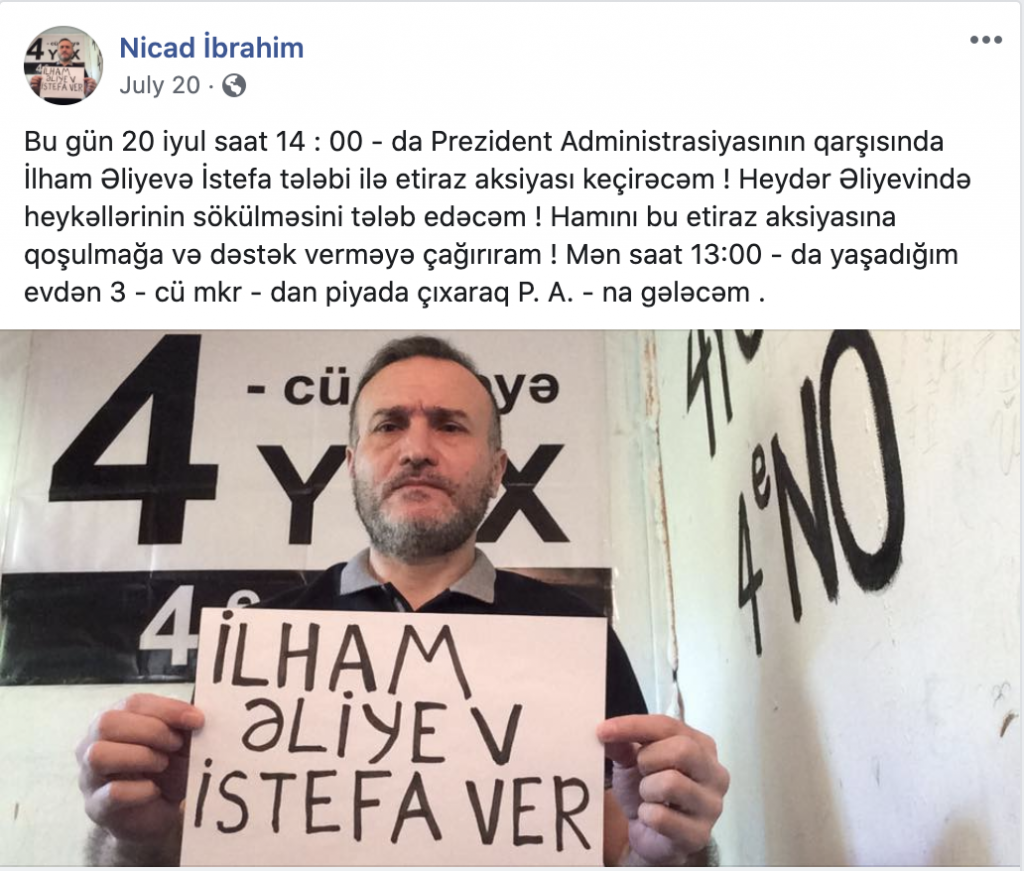
On July 20, activist Nijat Ibrahim, posted on his Facebook, that he was going to protest outside the Presidential Apparatus in the capital Baku. The main message of his one-man protest was calling on the President of Azerbaijan, Ilham Aliyev to resign. The activist also said he demands that the government demolish all of the monuments of Haydar Aliyev.
However, shortly after leaving his home, Ibrahim was detained by the police and charged with Article 139.1.1 of the Criminal Code (Violation of anti-epidemic, sanitary-hygienic, or quarantine regimes) specifically with spreading the virus. On July 21, Ibrahim’s wife, received a phone call informing her, her husband tested positive despite him never taking the testOn July 22, Nasimi district court found Ibrahim guilty and sentenced the activist to three months in pre-trial detention.
On July 28, Ibrahim’s lawyer filed a motion requesting the Center for Dangerous Infections at the Ministry of Health to provide information about the date Ibrahim was tested, and the results were made available to him. The court dismissed the motion.
According to the legislation, Ibrahim is facing 2500-5000AZN [1500-3000USD] fine, jail up to three years, or up to three years of restricted freedoms.
Scores of political activists have been accused of a similar crime over recent weeks.


![peace activists targeted online [updated]](https://www.az-netwatch.org/wp-content/uploads/2020/11/sergey-zolkin-_UeY8aTI6d0-unsplash-600x400.jpg)

![country-wide internet disruptions reported in Azerbaijan [updated]](https://www.az-netwatch.org/wp-content/uploads/2019/11/bandwidth-close-up-computer-connection-1148820-min.jpg)
![government in Azerbaijan threatens activists with interpol, again [update September 14]](https://www.az-netwatch.org/wp-content/uploads/2020/03/bill-oxford-OXGhu60NwxU-unsplash-600x332.jpg)
![activist blackmailed online [updated September 9]](https://www.az-netwatch.org/wp-content/uploads/2020/04/alex-ware-iIn8IKBOva0-unsplash-600x337.jpg)