Police in Baku detained a member of the opposition Popular Front party over social media posts according to reporting by Turan News Agency. Emin Akhundov was taken from his home on October 31 wrote Akhundov’s father on his Facebook. “Extraordinary things are happening in our country. Yesterday evening at around 19.30, two people from the Absheron district police department came to us, looking for my son (Emin Akhundov). I asked what was going on, and they said it was a minor issue, and that my son would be back home shortly.” Emin Akhundov was let go the next day according to members’ statements shared on Facebook.
It was not immediately clear what post or posts were the cause for Akhundov’s arrest. In a Facebook post, Emin Akhudnov shared shortly after his release, the activist did not share any additional information only that he was released and that he will continue his activism. Other members of the Popular Front Party took Akhundov’s detention as continued pressure against the party, especially in light of the recently organized protest in the capital Baku.
On October 6, the Baku Military court, sentenced reserve Colonel Elnur Mammadov to six months in prison. The court found Mammadov guilty of slander. Mammadov voiced criticism of the Ministry of Defense on social networks accusing it of cronyism and nepotism. The accusations were also leveled against the Ministry of Defense, Zakir Hasanov.
According to local media reports, the Ministry of Defense earlier responded to Mammadov’s criticism by refuting the colonel’s claims.
Mammadov said his arrest and sentence were directly linked to his social media commentary.
In one of his recent videos, Mammadov said despite his attempts to speak with the Ministry about ongoing nepotism and cronyism within the Army no one listened. Instead, he was dismissed. In its response, the MoD said Mammadov was discharged because of his illness.
This new OONI report provides an update based on the analysis of OONI measurements collected from Azerbaijan between May 2022 to September 2022. Access to the full report is available here.
Key findings
Blocked websites – measures show that at least 7 news media websites previously reported as blocked, remain inaccessible in the country. Among them are Radio Liberty, Azerbaijan Service for Radio Liberty, Meydan TV, and others. In addition, the measurements indicated that the authorities continue to block access to the Russian state-owned RIA-Novosti news site. This access block rolled out in June of this year. On June 4, the Ministry of Digital Development and Transport said in a statement the decision to block the Russian news website was a result of the news site running a story that was of defamatory nature against Azerbaijan. Specifically, the statement was referring to an interview published by RIA Novosti with Artak Beglaryan, the Minister of State of the disputed territory of Karabakh. In response, Azerbaijan Foreign Ministry accused Russia of “spreading slanderous information against the territorial integrity of Azerbaijan and promoting separatism” and violating “the 1997 Agreement on Friendship, Security, and Strategic Partnership between Azerbaijan and Russia, as well as the 2022 Declaration on Allied Cooperation, which requires both countries ‘to refrain from any activity directed against the principles of the UN Charter and each other’s sovereignty and territorial integrity,’ as well as ‘counter the threats of separatism.” On June 10, local media said RIA-Novosti removed the interview however, the site remained blocked in Azerbaijan.
Since Russia’s invasion of Ukraine, both Russia and Azerbaijan have blocked or discussed blocking each other’s news sites. The most recent OONI measurements show that the Russian internet regulator– Roskomnadzor blocked access to at least five Azerbaijani media domains from within the country.
Blocking of circumvention tool websites remained. TunneBear, Psiphon, Torproject were among circumvention tool websites that indicated signs of blocking. It is worth noting that not all networks were blocking these sites. And while the Psiphon and Tor Project websites might be blocked in Azerbaijan, their tools appear to work in the country (at least on tested networks).
Azerbaijan temporarily blocked access to the social media platform TikTok – the block remains in place according to the most recent measurement.
Stay tuned for the next quarterly report on measuring internet censorship in Azerbaijan.
Seymur Aghayev, a student, said police unlawfully took him to a police station where he was held for some two hours on September 27. The men who first asked Aghayev to confirm his identity were ununiformed explained Aghayev following his release. When Aghayev asked the reason for this inquiry his questions remained unanswered. The men put him in a car against his will and took him to the Baku Police Station.
“I was standing outside a grocery store when two men approached me, asking if I was Seymur. I told them that was my name. They were plainclothed and only later at the police station did I learn that the two men were the officers at Criminal Search department at the Baku City Police Station. They left my questions unanswered as we drove [to the police station],” Aghayev wrote the following day on his Facebook profile.
At the station, Aghayev was told the reason he was brought in was a Facebook status Aghayev shared about police violence against citizens.
In an interview with Toplum TV, Aghayev said, the status was referring to an old video of police using physical violence against a citizen. At the station, following the questioning (police officers also asked about his family members, their employment history, and any religious affiliation) Aghayev was forced to remove his Facebook status.
In its response to media inquiries, the Ministry of the Interior said there was nothing unlawful in Aghayev’s visit to the police. “He was questioned upon an invite. This is not unlawful,” said the Ministry’s media spokesperson in an interview with Meydan TV.
[Update] Speaking to a group of journalists on October 20, activist Ahmed Mammadli said his arrest was ordered by the state and that he was now being sent against his will to complete the compulsory military service less he drops his advocacy around peaceful coexistence between the two nations. The authorities said they would guarantee his safety and allow him to pursue his education abroad if he complied. But Mammadli is defiant and vowed to fight such measures from happening to any activist in the country. “I and our movement, won’t allow for this to happen again,” said Mammadli. “I refused their offer because my values are not for sale,” explained Mammadli to journalists at a press conference held in Baku shortly after his release from detention.
On September 20, police in Baku arrested a political activist, and the chairman of the Democracy 1918 (D18) movement Ahmed Mammadli. Mamadli was detained by men in non-uniforms and later sentenced to 30 days in administrative detention on bogus charges. The local police claimed Mammadli was arrested on the grounds of resisting the police.
Mammadli was among a handful of civil society activists who made public calls for peace, regarding the recent clashes between Armenia and Azerbaijan.
In his posts, Mammadli criticized the state for the recent clashes, saying the responsible officials, including the President of Azerbaijan, Ilham Aliyev, should be held accountable. “One day, Ilham Aliyev will answer before the international courts the crimes he committed not only against the Azerbaijani people but also against the Armenian people. The first task of a democratic Azerbaijan will be to punish those who make nations hostile to each other,” wrote Mammadli on September 15. In another post, Mammadli, called the president a “dictator” who had “blood on his hands”.
Mammadli announced he was going on a hunger strike following his arrest.
During the most recent clashes between Armenia and Azerbaijan, the State Security Service blocked access to TikTok.
Separately journalists from independent news platforms reported attempts to hack into their social media accounts during the most recent clashes due to their critical coverage. Verbal attacks on peace activists and journalists providing critical coverage of the escalations were also documented. Both journalists and activists said their social media accounts were getting temporarily suspended by Facebook as a result of mass (fake) reporting.
Giyas Ibrahim, was among those whose personal Facebook profile was suspended likely as a result of inauthentic accounts mass porting the profile to the platform and abusing the platform’s community standards. Although access to his profile resumed after the 6-day restrictions ended, the activist’s posts continue to be moved lower in the feed. In a notice Ibrahim received from Facebook, the platform claimed, Ibrahim posted something that violated Facebook’s policies.
In a separate case, activist and founder of Azad Soz platform, Tural Sadiqli said Facebook suspended access to his own profile over a post, the platform claimed was in violation of its community standards. The said post was about the story of a man who self-immolated outside a government building that normally provides citizens in need with housing. The rest of the post talked about the reactions of various government institutions including the one outside of which the man set himself on fire. This temporary suspension delayed Sadiqli’s work updating the Facebook page of Azad Soz, a popular anti-government online platform, that Sadiqli administers.
On September 22, Aziz Orujov, the director and founder of Kanal 13, an online television platform, was questioned by the Prosecutor’s General office, according to reporting by Meydan TV.
In an interview with Meydan TV, Orucov said, the Prosecutor’s Office claimed, Kanal 13 published video items damaging the reputation of the Azerbaijani Army, and casting a shadow on the strengthening work of the state’s defense capabilities.
Orujov said the allegations were not true.
The Prosecutor’s Office issued a warning to the channel’s director, based on the Information, Informatisation, and Protection of Information and On National Security laws. The office also said the channel removed the videos in question.
On September 16, Toplum TV, an online news platform had its Facebook page hacked. The hacker accessed the account by hacking one employee’s personal Facebook profile. As a result, the news platform lost 26k of its followers and two weeks’ worth of shared content.
In an interview with Meydan TV, the platform’s director, journalist Khadija Ismayil said this was not the first time Toplum TV was targeted with a digital attack.
AIW documented the previous attack in November 2021. At the time, the hacking occurred through an SMS interception. In another attack documented in September 2021, Toplum TV reported it lost 16k followers on its Facebook page.
Ismayil in a Facebook post said, there were suspicions that a similar attempt was made this time around. The admin team is investigating the origins of the hack.
Access to the page has been restored at the time of writing this post.
[Update] According to Turan News Agency reporting, the temporary ban on TikTok placed in September was removed. The decision was announced by the service for electronic safety at the Ministry of Digitial Development and Transport.
Users of the social media platform TikTok in Azerbaijan started reporting difficulties accessing the application as early as September 13. On September 14, the State Security Service announced its decision to block access to the platform entirely on the grounds the platform was casting a shadow over the military activities, revealing military secrets, and forming wrong public opinion.
According to testimonies of users in Azerbaijan, soldiers were sharing videos from the line of contact along the Azerbaijan-Armenia border. Some of these videos were graphic. Graphic videos also circulated on the Telegram app. OC Media reported about the first video while users said there was a second video resurfacing online.
Other users said they experienced issues accessing WhatsApp, Telegram, and slow internet connectivity speeds.
Azerbaijan Internet Watch together with partner organization OONI analyzed data provided by local testers on the ground and confirmed the blocking on the platform in Azerbaijan. The analysis revealed that TikTok was also blocked in Armenia.
The blocking came at a time of renewed clashes between Armenia and Azerbaijan.
According to the collected and analyzed OONI data,
the testing of www.tiktok.com and Tiktok endpoints presented a relatively large volume of anomalies between the 13th to 15th of September 2022, following the eruption of border clashes on the 12th of September 2022. It’s worth noting though that while www.tiktok.com measurements (showing signs of blocking) were collected from Azerbaijan from 13th September onwards, TikTok endpoint measurements are only available from 14th September 2022 onwards (when they were added to the test list for Azerbaijan).
In summary, based on the analysis of 681 OONI metrics collected from 5 different networks in Azerbaijan, we conclude that:
The main TikTok website (www.tiktok.com) and several endpoints essential to its functionality were blocked on at least 3 different networks (AS29049, AS41997, AS31721);
On all networks where we identified blocking, it seems to be implemented by means of TLS level interference by dropping packets after noticing a disallowed server_name;
ISPs in Azerbaijan block TikTok based on different lists of TikTok endpoint domains, and there is some level of inconsistency.
Separately journalists from independent news platforms reported attempts to hack into their social media accounts during the most recent clashes due to their critical coverage. Verbal attacks were also documented as was the case two years ago. Both journalists and activists said their social media accounts were getting temporarily blocked by the platforms as a result of mass (fake) reporting.
During the second Karabakh war, users in Azerbaijan faced internet restrictions as well. As a result, VPN usage soared during that period. In a statement issued by Access Now platform, Natalia Krapiva, Tech Legal Counsel at Access Now said, “Governments’ deep-seated drive to control the narrative — including in Central Asia and Eastern Europe — must stop.” “Whether authorities like it or not, people have the right to access the internet and to use social media, so focus on facilitating, not blocking.”
Earlier this week, on 12th September 2022, fighting erupted between Azerbaijani and Armenian troops along their border. Over the next few days, community members in Azerbaijan reported that the TikTok app was blocked locally.
In this report, we share our technical findings. In both Armenia and Azerbaijan, we found TLS and DNS level interference of TikTok domains and endpoints during the border clashes.
Background
On 12th September 2022, fighting erupted along the Azerbaijan-Armenia border between Azerbaijani and Armenian troops. The next day, Russia brokered a ceasefire, but it was immediately breached. Another ceasefire was announced in the evening of 14th September 2022 by the secretary of Armenia’s Security Council. Within 2 days of clashes, more than 100 Armenian and Azerbaijani soldiers were killed.
In 1994, the Armenian military secured victory over Nagorno-Karabakh and the seven adjacent regions in the aftermath of the first Karabakh war. Since then, Nagorno-Karabakh has been under the control of its ethnic Armenian population as a self-declared state. The two sides often blamed each other for violating the 1994 ceasefire agreement over the years with continued fighting. These clashes culminated in September 2020 during the second Karabakh war, with Azerbaijan regaining control over the previously occupied seven regions, as well as one-third of Karabakh itself. A ceasefire agreement signed on 10th November 2020 ended the hostilities temporarily. Despite both sides pledging to make progress towards a final peace deal and a series of high level meetings taking place since the second war, no significant progress on achieving a final peace treaty has been made.
During the 2020 Nagorno-Karabakh war, access to several social media platforms was blocked in Azerbaijan. At the time (between September 2020 to November 2020), OONI data collected from Azerbaijan showed that several social media websites (such as facebook.com and twitter.com) presented signs of blocking, while the testing of WhatsApp and Telegram presented signs of TLS level interference.
During the latest clashes over the last days, OONI data shows that these social media platforms appear to be accessible in Azerbaijan, but TikTok started to present signs of blocking. On 14th September 2022, Azerbaijan’s state security services announced the temporary suspension of social media platform TikTok. According to the statement, the content circulating on the social media platform was revealing military secrets and forming wrong opinions in society. As a result, the State Security Service decided to temporarily block access to the platform. Similarly, OONI data shows that the testing of TikTok also started to present signs of blocking in Armenia from 13th September 2022 onwards.
This study involves the analysis of OONI measurements pertaining to the testing of TikTok, collected from local networks in Azerbaijan and Armenia over the last days. In particular, we analyzed OONI Web Connectivity measurements pertaining to the testing of the TikTok homepage (https://www.tiktok.com), as well as several other web resources that are needed for the TikTok web app and mobile app to function (hereafter referred to as “TikTok endpoints”). We thank a community member who kindly shared with us a list of TikTok endpoints, which were subsequently added (to the lists of URLs measured by OONI Probe users in Azerbaijan and Armenia) for testing. OONI’s URL prioritization system ensures that once URLs are merged into the Citizen Lab test lists, they are immediately prioritized for OONI Probe testing. As a result, measurements from the testing of TikTok endpoints were collected almost immediately from both Armenia and Azerbaijan (supporting this study).
OONI’s Web Connectivity experiment is designed to measure the accessibility of URLs by performing the following steps:
Resolver identification
DNS lookup
TCP connect to the resolved IP address
TLS handshake to the resolved IP addresses
HTTP(s) GET request
The above steps are automatically performed from both the local network of the user, and from a control vantage point. If the results from both networks are the same, the tested URL is annotated as accessible. If the results differ, the tested URL is annotated as anomalous, and the type of anomaly is further characterized depending on the reason that caused the failure (for example, if the TCP connection fails, the measurement is annotated as a TCP/IP anomaly).
Each Web Connectivity measurement provides further network information (such as information pertaining to TLS handshakes) that helps with evaluating whether an anomalous measurement presents signs of blocking (or is a false positive). Based on our heuristics, we are able to automatically confirm the blocking of websites if a block page is served, or if DNS resolution returns an IP known to be associated with censorship (and such fingerprints have been added to our database).
In the cases of Azerbaijan and Armenia, we have never come across block pages, limiting our ability to automatically confirm cases of blocking with confidence. Instead, ISPs in both Azerbaijan and Armenia appear to adopt different censorship techniques (as discussed, for example, in our previous research examining blocks in Azerbaijan), requiring more manual analysis of measurements for the confirmation of blocks. This study focused in the case of Azerbaijan, we analyzed network measurement data provided under the network_events keys of Web Connectivity measurements, which provided insight on TLS level interference of TikTok endpoints. In the case of Armenia, we analyzed both TLS handshakes and DNS query results. Another limitation to our study is the limited OONI measurement coverage from Azerbaijan (in comparison to Armenia and other countries). Generally, the larger the relevant measurement volume, the greater our ability in identifying and confirming blocks.
Findings
OONI data shows that both Azerbaijan and Armenia started blocking access to TikTok right after clashes erupted along their border.
Blocking of TikTok in Azerbaijan
We analyzed OONI measurements collected from Azerbaijan from 13th-15th September 2022 and noticed that many of them appear to time out when attempting to establish a TLS handshake to the target endpoint.
While many such measurements are annotated (on OONI Explorer) as presenting DNS inconsistency, we were able to exclude that by validating that the returned IPs are able to complete a TLS handshake with a valid certificate for the target domain name. Moreover, when issuing an HTTP request with the appropriate headers, the response payload is consistent with the response from an endpoint served to a user in Europe. By inspecting the response header and server certificate, it seems to be an Akamai cache.
To evaluate the extent to which the blocking is happening and establish if it’s in fact caused by an intentional block, we analyzed the values of the network_events keys of Web Connectivity measurements. These keys contain very rich information on every read and write operation performed during a TLS handshake.
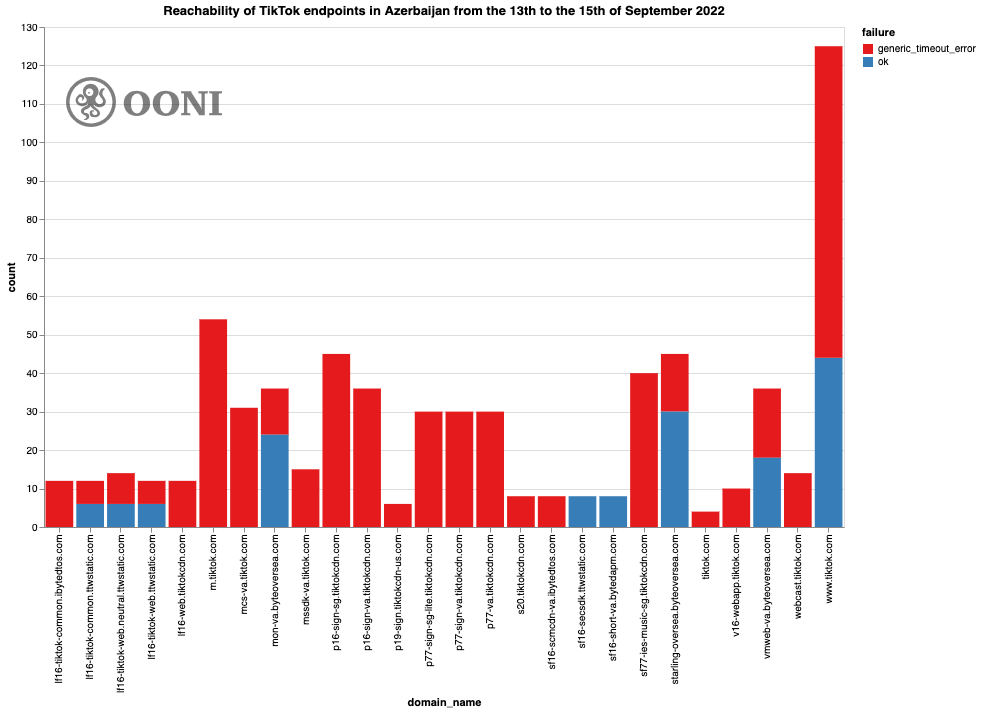
In the following charts, we consider a single “datapoint” as a single network event transcript (i.e. a TLS handshake operation towards a certain IP, port, server_name tuple). When grouping the measurements by server_name, we can see that most domains fail quite consistently, yet some of them don’t fail as often as others.
Chart: OONI data on the testing of tiktok.com and TikTok endpoints in Azerbaijan between 13th-15th September 2022.
As is evident from the above chart, the testing of www.tiktok.com and Tiktok endpoints presented a relatively large volume of anomalies between 13th to 15th September 2022, following the eruption of border clashes on 12th September 2022. It’s worth noting though that while www.tiktok.com measurements (showing signs of blocking) were collected from Azerbaijan from 13th September onwards, TikTok endpoint measurements are only available from 14th September 2022 onwards (when they were added to the test list for Azerbaijan).
As a result, based on available OONI data, we can only confirm that the blocking of TikTok in Azerbaijan started the latest at the following times, on the following networks:
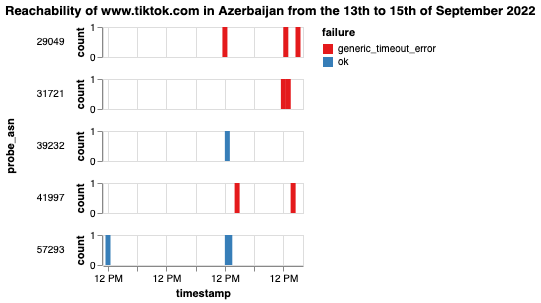
The OONI Probe testing of www.tiktok.com on 5 networks in Azerbaijan between 13th to 15th September 2022 can be further examined through the following chart, which shows that its testing consistently presented generic_timeout_errors on at least 3 networks by 15th September 2022.
Chart: OONI Probe testing of www.tiktok.com on 5 networks in Azerbaijan between 13th-15th September 2022.
In the above cases, we can see that attempts to connect to www.tiktok.com failed due to a connection timeout. Upon inspecting relevant network measurement data, we see that this always happened after the first write operation (the one responsible for writing the ClientHello which contains the server_name field (SNI)), which is consistent with the hypothesis that the block is some form of TLS based interference, possibly by looking at the SNI field of the ClientHello message.
The blocking looks quite consistent on a per domain basis, which is compatible with the hypothesis that it’s some sort of SNI-based TLS level block.
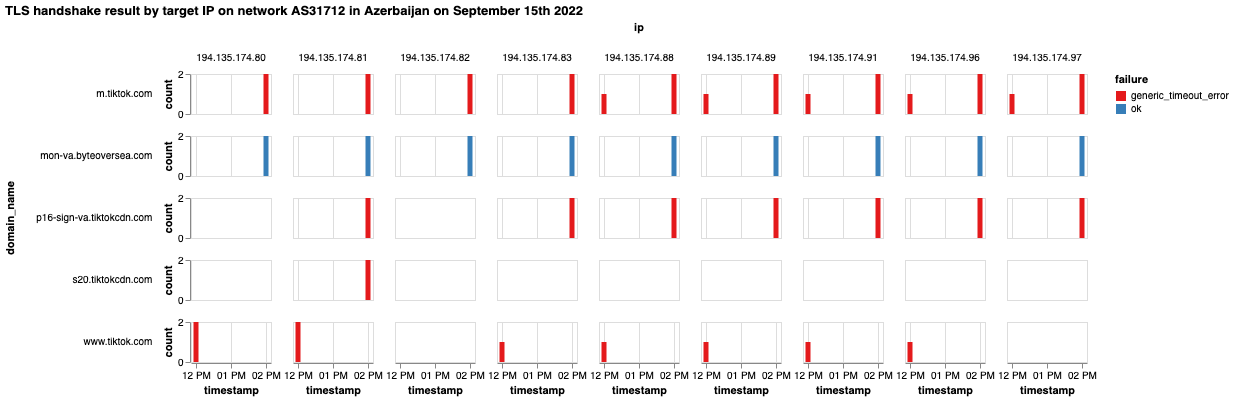
To additionally support this claim, we notice that several different domain names resolve to the same IP address. When looking at the TLS reachability of the same IPs on a particular network, but with a different server_name value, we can see (by reading the chart horizontally) that they are consistently reachable when a specific server_name is provided, as illustrated below.
Chart: OONI data on TLS handshake results by target IP on network AS531712 in Azerbaijan on 15th September 2022.
On the other hand, if you read the chart vertically you can see that the same IP is both reachable and unreachable depending on the domain_name value.
This strongly suggests that the block is intentional and a consequence of filtering of those particular domain names.
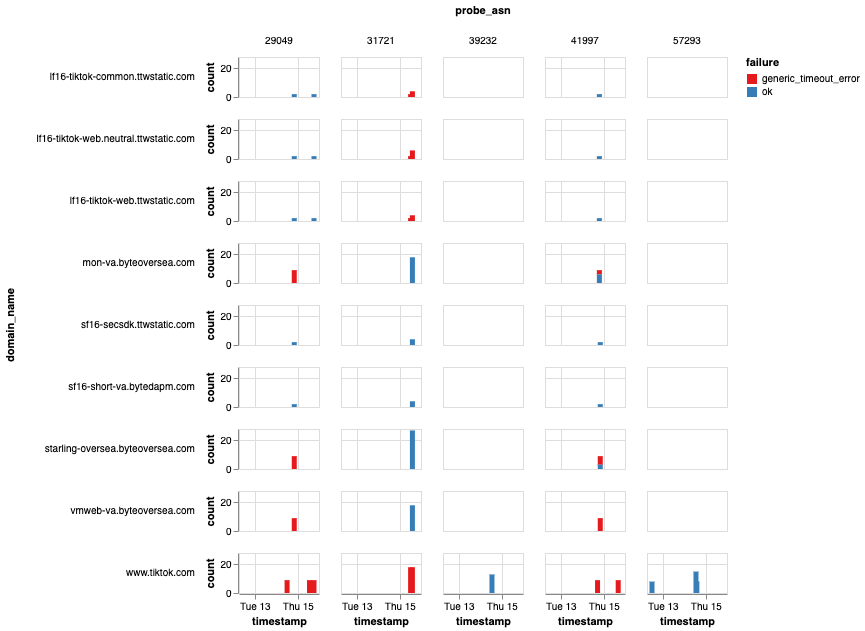
When looking at the subset of domain names that are not consistently blocked, we can see that they are consistently blocked within the same network, which leads us to believe that there are different filtering policies deployed across networks.
Chart: OONI data providing a per-ASN comparison on the testing of www.tiktok.com and TikTok endpoint domains in Azerbaijan between 13th-15th September 2022.
In summary, based on the analysis of 681 OONI metrics collected from 5 different networks in Azerbaijan, we conclude that:
The main TikTok website (www.tiktok.com) and several endpoints essential to its functionality were blocked on at least 3 different networks (AS29049, AS41997, AS31721);
On all networks where we identified blocking, it seems to be implemented by means of TLS level interference by dropping packets after noticing a disallowed server_name;
ISPs in Azerbaijan block TikTok based on different lists of TikTok endpoint domains, and there is some level of inconsistency.
Blocking of TikTok in Armenia
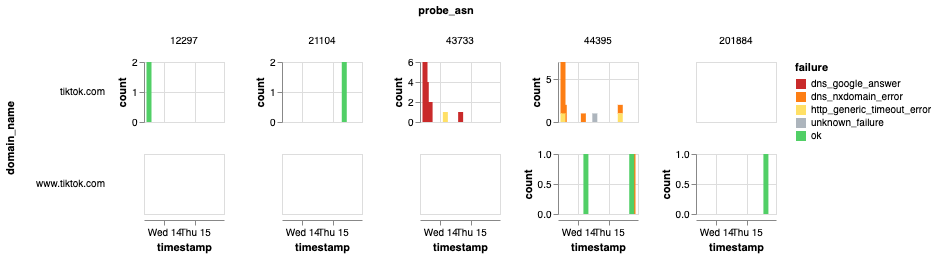
OONI data shows the blocking of TikTok in Armenia on 13th September 2022. Out of the 5 networks from which TikTok measurements were collected, we are able to establish that the blocking began on 2 of them on 13th September 2022. Specifically:
The following chart shares OONI data on the testing of www.tiktok.com and tiktok.com from 5 networks in Armenia between 13th-15th September 2022.
Chart: OONI data on the testing of tiktok.com and www.tiktok.com on 5 networks in Armenia between 13th-15th September 2022.
As is evident from the above charts, these ISPs in Armenia seem to employ a mix of different techniques to implement the blocking of TikTok. In the case of Ucom (AS44395), they appear to mostly return an NXDOMAIN error when the TikTok domain is queried.
In the case of MTS Armenia (AS43733), it’s interesting to note that upon querying the tiktok.com domain, the IP address 172.217.17.228 is returned, which is associated with www.google.com. It’s also worth noting that the TLS handshake timed out, which is not consistent with the behavior of the real server, which may indicate that they implement an additional TLS layer block on top of the DNS level interference.
It’s also interesting to note that the nameserver for MTS Armenia allows us to do a zone transfer for tiktok.com and through that we are able to see the tainted google IP A record:
$ dig @ns.mts.am tiktok.com axfr
; <<>> DiG 9.16.22-Debian <<>> @ns.mts.am tiktok.com axfr
; (1 server found)
;; global options: +cmd
tiktok.com.                1800        IN        SOA        ns2.mts.am. ns.mts.am. 2020101600 3600 600 1296000 3600
tiktok.com.                1800        IN        NS        ns2.mts.am.
tiktok.com.                1800        IN        NS        ns.mts.am.
tiktok.com.                1800        IN        A        172.217.17.228
tiktok.com.                1800        IN        SOA        ns2.mts.am. ns.mts.am. 2020101600 3600 600 1296000 3600
;; Query time: 95 msec
;; SERVER: 217.76.1.85#53(217.76.1.85)
;; WHEN: Thu Sep 15 23:54:58 CEST 2022
;; XFR size: 5 records (messages 1, bytes 196)
No other tested TikTok endpoints allow zone transfers from the MTS nameserver, nor any other domain which we tested. This might be due to the fact that to implement the block the zone for tiktok.com was set up quickly and they forgot to disable zone transfers on it.
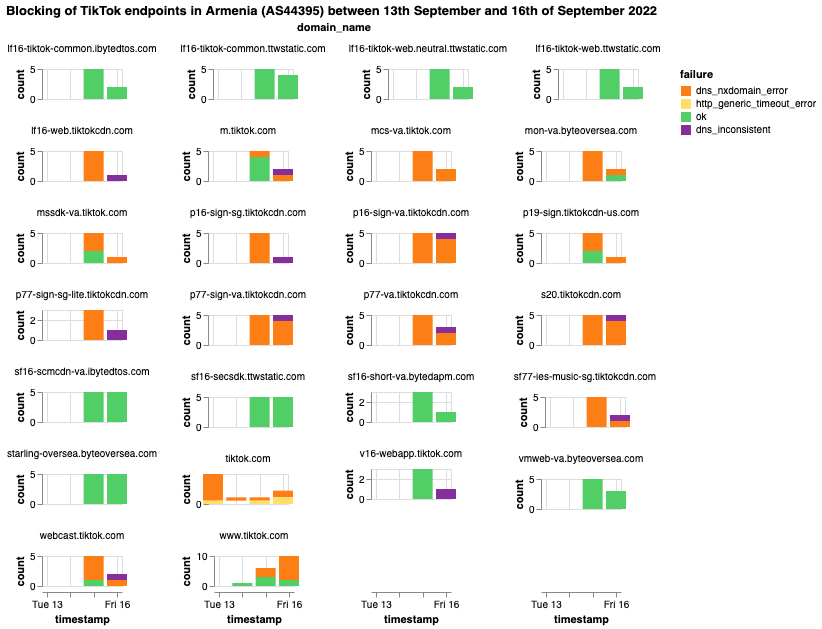
By focusing our attention on the Ucom network (AS44395), we can see that not all TikTok endpoints appear to be blocked.
Chart: OONI data on the testing of TikTok endpoints on Ucom (AS44395) in Azerbaijan between 13th-16th September 2022.
Interestingly, starting from today (16th September 2022), the DNS response appears to be inconsistent and returns an IP address that has an expired letsencrypt certificate. When accessed, it will direct to:
$ openssl s_client -connect 95.216.36.80:443
CONNECTED(00000003)
Can't use SSL_get_servername
depth=1 C = US, O = Let's Encrypt, CN = R3
verify error:num=20:unable to get local issuer certificate
verify return:1
depth=0 CN = it.domain.name
verify error:num=10:certificate has expired
notAfter=Jun 12 15:18:58 2021 GMT
verify return:1
depth=0 CN = it.domain.name
notAfter=Jun 12 15:18:58 2021 GMT
verify return:1
---
Certificate chain
 0 s:CN = it.domain.name
   i:C = US, O = Let's Encrypt, CN = R3
   a:PKEY: rsaEncryption, 2048 (bit); sigalg: RSA-SHA256
   v:NotBefore: Mar 14 15:18:58 2021 GMT; NotAfter: Jun 12 15:18:58 2021 GMT
 1 s:C = US, O = Let's Encrypt, CN = R3
   i:O = Digital Signature Trust Co., CN = DST Root CA X3
   a:PKEY: rsaEncryption, 2048 (bit); sigalg: RSA-SHA256
   v:NotBefore: Oct  7 19:21:40 2020 GMT; NotAfter: Sep 29 19:21:40 2021 GMT
---
In all other cases of blocking, we notice that the HTTPS request times out, which leads us to believe that they might be using some form of TLS level interference.
To summarize:
Armenia has been blocking TikTok since at least 13th September 2022 on at least two networks (AS44395, AS43733);
On most networks, TikTok interference was observed at the DNS level by returning an NXDOMAIN error, an IP address associated with www.google.com, or a set of unrelated IP addresses which contain an expired certificate for the server_name it.domain.name;
Not all tested networks in Armenia implemented the TikTok block and censorship techniques varied from network to network;
Several endpoints used by the TikTok app and website are also blocked on at least one network in Armenia.
Conclusion
Social media censorship often appears to be weaponized during conflicts and other moments of political turmoil around the world. By controlling the flow of information on social media platforms, governments may attempt to control the narrative surrounding political events. Over the last 6 years, OONI data has shown that access to major social media platforms is commonly blocked during elections and protests around the world. Earlier this year, Russia ramped up its censorship following the war in Ukraine.
[Update] On February 26, Zeynalli was sentenced to nine years behind bars, while Shukurov received a four-year sentence.
[Update] On January 5, the Baku Court of Appeals ruled in favor of the December 29 court decision [see previous updates below]. According to the appellate court’s ruling, releasing Zeynalli under house arrest would interrupt the course of the investigation, reported Meydan TV on January 6, 2023.
[Update] On December 29, 2022, a local court in Baku ruled to extend the detention period of journalist Zeynalli for another three months, reported Meydan TV. Zeynalli’s lawyer said they will be appealing the decision.
[Update] According to reporting by Meydan TV, The General Prosecutor’s Office claims that journalist Avaz Zeynalli conspired with others in extortion. The journalist is accused of collaborating with the head of Seda TV, Elnur Shukurov, in getting permission for land privatization in Baku and Sumgayit. Shukurov was arrested on September 15 on charges of unlawful influence on the decision of an official. The Prosecutor’s Office alleges that Shukurov and Zeynalli exerted influence over executive authority office employees to grant permission for land privatization.
According to Turan News Agency, Seda TV is a relatively small YouTube channel with just over 50k subscribers and is managed solely by Elnur Shukurov.
***
[Update] On September 16, during the court hearing, it was decided that the investigation could continue while Sadigov transferred under house arrest.
***
Avaz Zeynalli is a journalist and editor of Khural newspaper. He was arrested on September 10 after a pro-government news platform falsely accused Zeynalli of extortion. The same platform also mentioned that human rights lawyer Elchin Sadigov acted as an intermediary in the alleged scheme. As a result, Sadigov was also arrested along with Zeynalli. Police also searched and confiscated the documents and devices of both Zeynalli and Sadigov.
According to reports, Zeynalli was charged with “large-scale bribe-taking” and Sadigov with “complicity in bribe-taking.” Both are facing between 8 and up to 12 years in prison if found guilty.
Both Sadigov and Zeynalli were sentenced to four months in pre-trial detention.
Zeynalli served three years behind bars on bogus bribery, extortion, and tax evasion charges (between 2013 and 2016). Sadigov is known for representing cases of political prisoners in Azerbaijan.



![police detains peace activist. meanwhile activists face restrictions on Facebook [Updated October 24]](https://www.az-netwatch.org/wp-content/uploads/2022/04/roman-martyniuk-QQhAQHWvTYk-unsplash-600x337.jpg)


![in Azerbaijan State Security Service blocks TikTok during the most recent clashes [Updated November 7]](https://www.az-netwatch.org/wp-content/uploads/2021/04/solen-feyissa-1S1w1c4_VyA-unsplash-600x400.jpg)