Azerbaijan using FindFace technology (Qurium Forensics)

On December 4, Qurium released a report documenting how Azerbaijan may have been using FindFace technology. In its analysis, Qurium was able to identify that a server in Azertelecom – backbone internet provider – runs Find Face version 4.0.2.

Find Face made the news in 2016 when its developer NTech lab announced the app as a consumer-oriented facial recognition service, intended for mining data from VKontakte. But the publicity storm ended with NTech Lab announced its decision to withdraw the service from public access and redirect it towards global projects in security and retail (used for instance to identify emotions of customers).

Azerbaijan is already among the customers of Huwai’s facial recognition technology. And in April, Zakir Karimzade, the head of Audatex Azerbaijan said in an interview with a local paper, there was interest in creating a local facial recognition system.

Also in June 2019, Baku was host to the World Customs Organisations (WCO) conference. Among many new technologies discussed and presented at the event, was facial recognition technology.

News website blocked in Azerbaijan (Qurium Forensics)

According to a forensic report released by Qurium on December 10, Gununsesi.org – an opposition website in Azerbaijan – it was possible to conclude that the website was blocked by means of Deep Packet Inspection (DPI).

DPI “is a type of data processing that inspects in detail the data being sent over a computer network, and usually takes action by blocking, re-routing, or logging it accordingly.”

Gununsesi.org is among fifty plus websites currently being blocked in Azerbaijan.

Activist’s YouTube channel down

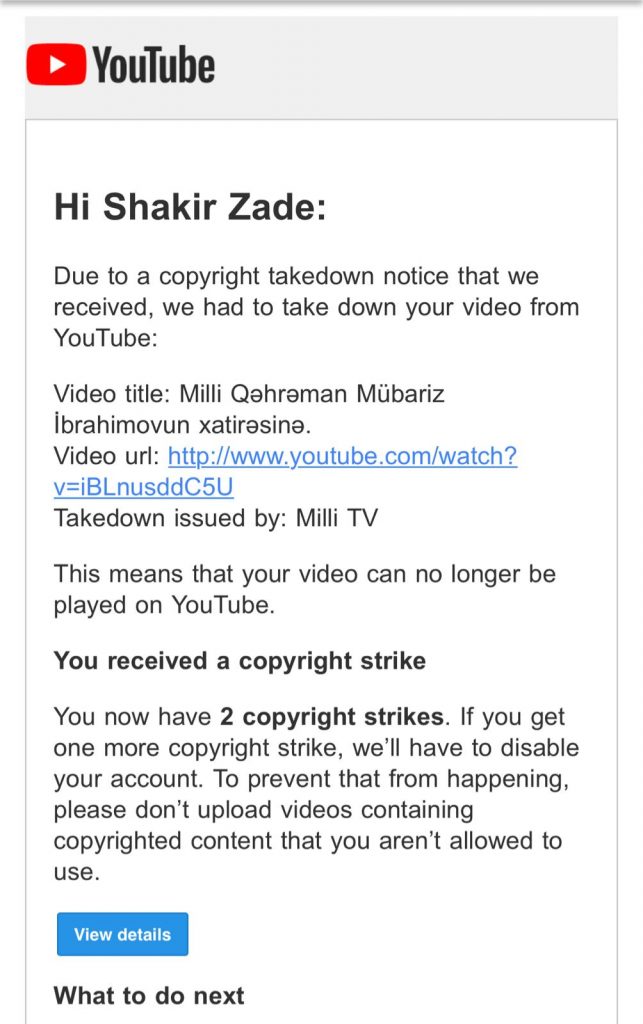
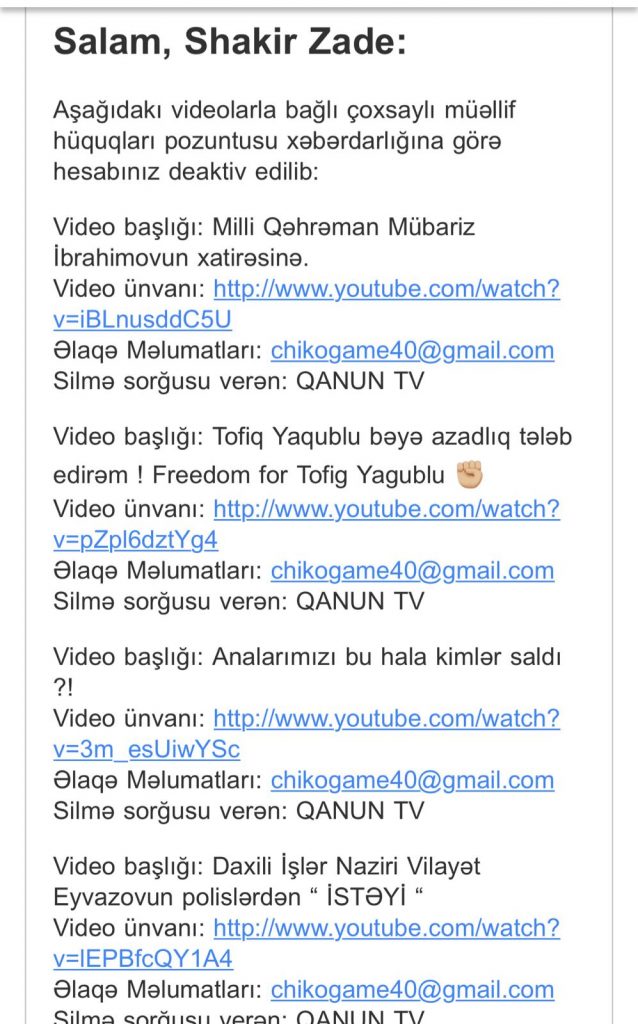
On December 5, Shakir Zade, Azerbaijani activist living abroad, reported his YouTube channel was taken down by the platform following takedown requests made by Milli TV, Qanun TV and AnTV.

Following the incident, it was possible to identify that Milli TV and Qanun TV were working together, however, since the incident, it has been not possible to locate the admins of either of the YouTube channels or the Milli TV YouTube channel.

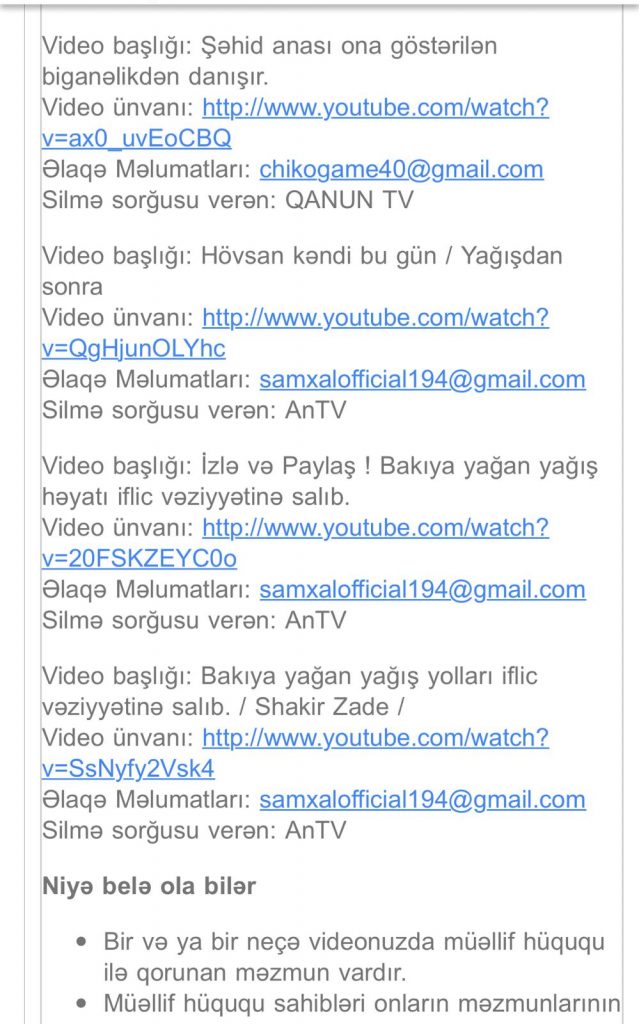
On December 10, it was still possible to see, two email addresses that were connected to each of the YouTube channels – chikogame40@gmail.com (Qanun TV) and efs9797@mail.ru (Milli TV). However, since Zade’s channel was restored, this information appears to be missing, as well as any traces of Milli TV on YouTube. The following message appears when using the previous link associated with Milli TV.

Zade also said, he was reached out by the admin of AnTV who informed Zade, his personal account was hacked during the reporting and that it was not the original owner of the channel who reported Zade’s YouTube channel.

This is not the first time, YouTube accounts, Facebook accounts, or Instagram accounts have been taken down by the companies following “takedown requests” by contentious users in Azerbaijan.

Update: December 19, 2019

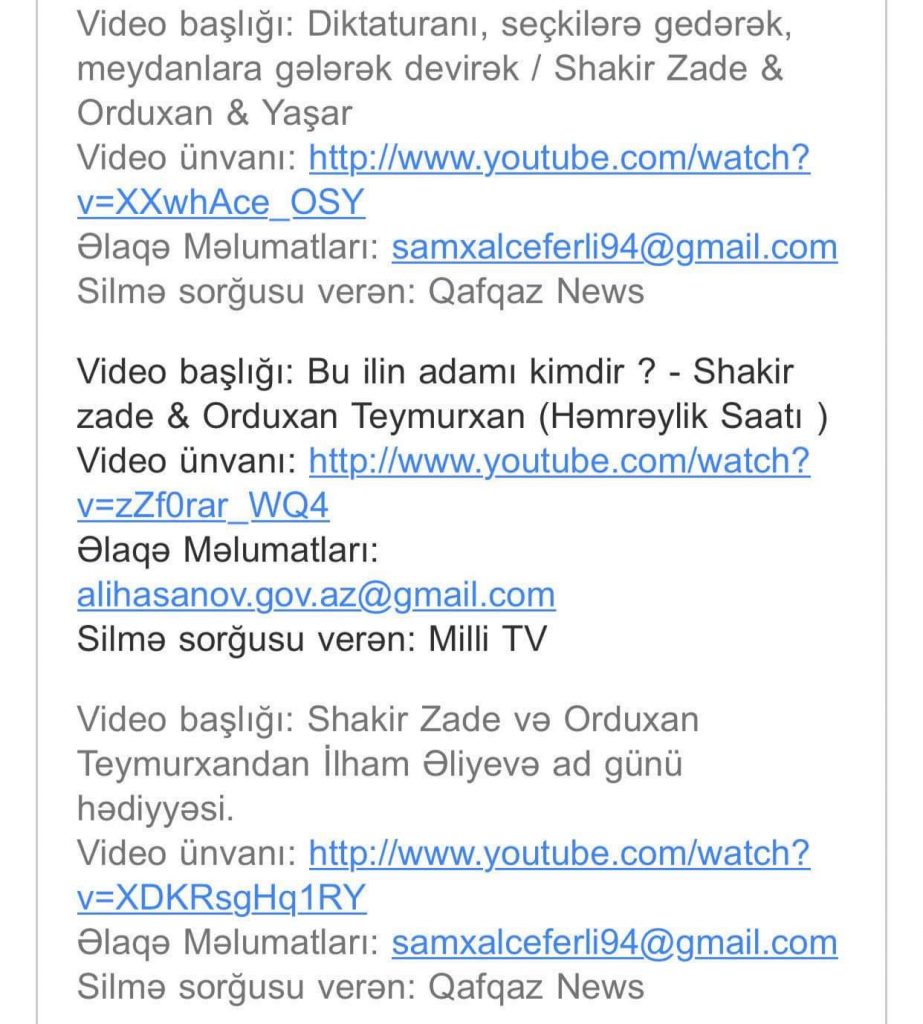
Shakir Zade’s YouTube account was once again reportedly taken down by the YouTube platform after a series of “copyright violation” reports sent in by AnTV and Qafqaz News accounts.

The alleged victim who claims the videos were a copyright violation is registered at samxalceferli94@gmail.com and samxalofficial194@gmail.com. administers AnTV and Qafqaz News.

Update: January 3, 2020

YouTube once again has closed down Shakir Zade’s YouTube channel, on what seems like yet another false copyright violation report.

This time, Milli TV appeared to have a new email: alihasanov.gov.az@gmail.com. Ali Hasanov is a former aid to the president. He was known prior to his dismissal as the man behind media censorship in Azerbaijan. He was dismissed on November 30, 2019 as part of alleged reforms introduced by the president Ilham Aliyev.

Political leader’s Instagram page down

On December 1, Ali Karimli, leader of the opposition party Popular Front reported his personal Instagram profile, taken down by Instagram without any notification.

This is not the first time Karimli’s Instagram profile is targeted. However, it was the first time, a fake account was created in his name in order to take down his original account.

On December 4, Karimli received a text message from Instagram with the following message: “Your Instagram account temporarily disabled. Please confirm your personal account.” The message contained a link, which navigated you to a picture of a man wearing a suit (unrelated to the leader of the opposition party).

Karimli said, he never had his personal mobile number associated with an Instagram account and he suspected that whoever was behind the attack, set up an account in his name, registering it to his number. It is possible it was this disabled account that was used to report his original account on the grounds of impersonating the original user. 

Political figure Facebook page hacked

On November 9, 2019, political activist and public figure, Gultekin Hajibeyli realized her Facebook page where she had some 200,000 followers was hacked. Hajibeyli’s page contains information about her recent work, speaking engagements, and interviews.

Following the hacking, Hajibeyli lost all of her archives and some 130,000 of her followers.

Although it was possible to return Hajibeyli’s page following the hack, it is still not clear whether the political activist will regain access to her deleted archive and removed followers.

Azerbaijan ranked “not free” in a new report by Freedom House

On November 5, Freedom House released the new edition of Freedom on the Net report. The report ranks 65 countries.

According to 2019 Freedom on the Net report, Azerbaijan was downgraded to “not free” scoring 39 out of 100.

The already poor state of internet freedom in Azerbaijan continued to deteriorate during the coverage period. Access is inhibited by infrastructural challenges—illustrated by a major power outage in July 2018—and by state control over the information and communication technology (ICT) industry. The government manipulates the online information landscape, blocking websites that host unfavorable news coverage and using automated “bot” accounts to spread propaganda. Digital rights are not respected, and those who voice dissent online can expect prosecution if they reside in the country or various forms of intimidation if they live abroad.

Read the report.

opposition movement facebook page hacked

Opposition movement D18 reported it’s Facebook page was hacked by unknown perpetrators. While the administrators realized they were no longer in control of the page, they were unable to prevent the loss in the number of page likes. 

In just twenty minutes, the group lost over 7000 likes. 

To avoid, further intrusion, the administrators of the page deactivated the page while trying to strengthen the security of the page. 

The same day, one of the founders of the movement, Ruslan Izzetli, reported his personal Facebook page, being hacked. While, Izzetli was able to return his page, it was while the page was taken over, that the D18 page was hacked. Izzetli and other members of D18 movement believe the attack was targeted and was the result of a recent Facebook post the group shared on their page, calling on the current Minister of Internal Affairs, Vilayet Eyvazov’s resignation. 

internet connection down during political rally

Internet connections were reportedly down Saturday, October 19, 2019.

While no official explanation was provided for the reasons of poor connectivity, civil society activists say authorities cut off the internet connection on purpose to prevent political activists and participants of the opposition rally to share and report updates from the unsanctioned political rally organized in the capital of Baku on October 19.

The rally took place in multiple locations across downtown Baku, as a result, users reported connectivity problems throughout the day, across the center of Baku.

According to reports, in addition to mobile internet connection not working, some landlines and wifi connections across the downtown area were reportedly down.

Elesger Ahmedoglu, a media law expert, wrote on his Facebook, the situation was akin to an emergency. “Mobile operators and internet providers caused damage worth in millions by cutting off mobile internet for hours on end, both to the business owners and public. This is a serious violation of rights and anyone affected, must appeal to courts,” wrote law expert.